

Being expected to manage salary of ₹30,000 per month in the year 2026 can be quite overwhelming. The fact is, the level of inflation has not decreased, the cost of living has gone up, and the social culture of ‘living better’ has never been more prominent than it is today. Let me be clear: I’m not one of these financial commentators with ‘crores in their bank account,’ but an ordinary individual who trade part-time, who knows, through some very painful experiences, how important it really is to manage one’s finances properly.
The reality remains: if you manage the money well, even ₹30,000 per month isn’t bad. Financial stress isn’t just the result of having lower incomes. Financial stress ends up occurring for those who are struggling with unorganized finances, unorganized planning, or emotional expenditures. This blog post shall help you learn to manage your salary in 2026 without burnout, guilt, or anxiety.
Why Managing a ₹30,000 Salary Matters More in 2026
In 2026, money is no longer a matter of mere survival. Instead, it was related to stability and peace of mind.
Key facts about 2026:
- Higher rent and utility costs
- Increased digital spending: subscriptions, apps, EMIs.
- Easy access to credit provided through BNPL and instant loans.
- Increasing healthcare and insurance costs
- Strong influence of lifestyles on social media
If you don’t actively manage salary, money will disappear before the month is through, and savings will remain a dream.
Understanding Your ₹30,000 Manage Salary in Practical Terms
Before budgeting, clarity is needed.
₹30,000 a month means:
- ₹1000 per day (approx.)
- ₹365,000 yearly
This salary can support:
- Basic urban or semi-urban living
- Modest savings
- One or two financial goals – if it is well planned.
Yet, it cannot support everything at once, and there is where most people go wrong.
Main Reasons People Struggle to Manage Salary Effectively
1. There is no clear money
In most people’s finances, there are no roles to be played by the cash. There comes the income, and there comes the expenses randomly
2. Upward Lifestyle
As income raises slightly, expenditures escalate rapidly: food delivery, gadgets, holidays.
3. Overlooking Small Leaks
If daily amounts of ₹150-₹200 are spared, they will seem unimportant
4. No Emergency Buffer
One medical bill or repair fix can ruin the entire month.
The Real Impact of Poor of Manage Salary
When you don’t manage salary properly, the effects go beyond money.
- Constant financial stress
- Zero savings despite working hard
- Dependence on credit cards or loans
- Lacking the confidence to invest or trade.
- Life goals delayed: travel, marriage, business, investment
It has happened to a number of traders I have seen who, after having highly profitable months, blew up due to messy personal finances. Profits in trading mean absolutely nothing if your base salary is unstable.
Signs You’re Not Managing Your Salary Well
If you identify with 2 or more of the statements above, the time has come to take action:
- Salary ends before the 25th
- Where did the cash go?
- Savings occur only when something is left.
- Often borrowing from friends.
- Fear of checking bank balance
- No emergency fund
Why Common Salary Advice Fails
Most advice goes like this
“Save more, spend less.”
Such a strategy would never succeed in the real world.
Why?
- It does not take into account fixed costs
- It doesn’t match Indian salary realities
- It doesn’t allow enjoyment
- It is not flexible for emergencies
You need a system, not motivation.
Practical Salary Management Strategy for ₹30,000 (2026-Friendly)
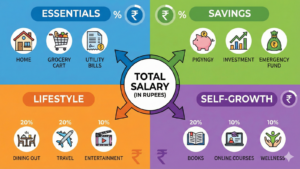
Step 1: Use the 4-Bucket Salary System
Instead of all the calculations associated with budgets, you would simply allocate your income into four buckets.
Example Breakdown:
1.Essentials – 50%
- Rent
- Groceries
- Transport
- Utilities
2.Savings & Investments – 20%
- Emergency fund
- SIP or RD
- Long-term investments
3.Lifestyle – 20%
- Eating out
- Entertainment
- Shopping
4.Self-Growth & Safety
- Skill acquisition
- Health
- Premium payments
“This structure sustains life in balance—not in restriction.”
Step 2: Automate Savings When Salary is Paid
The first, most important rule that I take care to follow as a professional and a trader:
Save first. Spend later.
- SIP/RD: Start SIP/RD on the 1st or salary date
- It is essential to treat savings like fixed expenditures because you need
- Never wait for ‘leftover money’
Onboarding becomes very efficient.
Step 3: Create an Emergency Fund
Before trading actively or seeking high returns:
- Save ₹50,000 to ₹1,00,000 as an
- Put it into liquid funds or high-interest savings
- It offers a means to avoid debt in times of crises
“No emergency fund means constant anxiety.”
Step 4 Spend Smart, Not Cheap
Managing salaries doesn’t mean managing joy
Smart Spending Ideas:
- Limit delivery of foods to Chosen days
- Follow up on magazine subscriptions on
- Purchase Quality Rather than Cheap Multiple Times
- Use cash or UPI for day-to-day expenses (helps create awareness)
“The objective is conscious spending, not sacrifice.”
Step 5: Start Small Investing (Even ₹1,000 Matters)
At ₹30,000 per year, it’s possible to
- ₹1,000-₹3,000 SIP
- Index or Balanced Funds
- Avoid risky leverage or hype investments
As a trader, I have learned:
Regular small investments are always better than irregular large investments.
What Happens If You Ignore Salary Management in 2026
Ignoring that will result in:
- Rollover of debts from
- Debt dependence
- No capital available for trading and investments
- Stress affecting health and relationships
- Missed years for accumulating wealth
Money is cheaper than time.
Final Thoughts
Managing a ₹ 30,000 salary in the year 2026 is about thinking better, not earning more.
I’ve learned, as a full-time employee and a part-time trader, how financial peace comes from systems and not levels of income. When you manage salary intentionally, stress reduces, confidence grows, and opportunities open up.
Start small, stay consistent. Your future self will thank you.
NOTE: This content is for educational purposes only. No financial advice or guarantees.