

Introduction: Why ₹5,000 Best SIP Matters More Than Ever in 2026
₹ 5,000 would seem less to you in 2026. The inflation is high, lifestyles costly, and all those around you online pretend to make “quick money.” But as someone who manages a full-time job, part-time trading, and consistent investing ( Saving ) , I confidently say,
A disciplined ₹5,000 Best SIP, if invested smartly, can outperform most random high-risk bets.
It’s not the amount that’s the difference.
The difference is where you make the investment and how. This blog breaks down the best SIP options in 2026, realistic return expectations, common mistakes, and how a normal working professional can turn ₹5,000/month into meaningful long-term wealth.
What Does “Best SIP” Really Mean in 2026?
The concept of Best SIP has evolved.
Earlier, it meant:
- One good mutual fund
- Fixed Asset Allocation
- Minimum monitoring
In 2026, Best SIP means
- Adaptive to market cycles
- Balanced between growth and stability
- In tune with your personal goals, not social media trends.
AI trading, along with global volatility and changing interest rates, have actually made SIP investments intentional-even with small amounts.
Why Old SIP Thinking Fails Today
Many investors still believe:
- “Small SIP won’t make a difference”
- “Only large-cap funds are safe”
- “One fund is enough”
Based on my trading experience, I have witnessed the failure of a portfolio not because of a lack of funds but because of the following reasons:
-
Over-concentration
-
No Review Process
- Emotional Investing During Corrections
For example, an SIP worth ₹5,000 requires planning
How ₹5,000 Best SIP Can Grow (Reality Check)
Let’s be practical.
-
₹5,000 per month = ₹60,000 per year
-
Over 15 years = ₹9,00,000 invested
Depending on ROI :
-
10% CAGR → ~₹21–22 lakhs
-
12% CAGR → ~₹25–26 lakhs
-
14% CAGR → ~₹30+ lakhs
The difference between 10% and 14% is not luck. It is allocation, discipline, and patience.
Best SIP Allocation Strategy for ₹5,000 in 2026
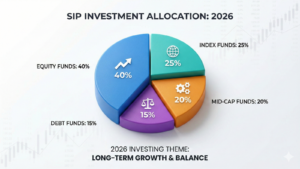
1. ₹2,000 – Flexi Cap / Multi-Cap Fund (Core Growth)
Why it works:
Flexi-cap funds allow fund managers to shift between large, mid, and small caps based on market conditions.
Best for:
- Working professionals
- Long-term wealth creation
- Investors who don’t follow markets every day
This is the foundation of your SIP portfolio.
2. ₹1,500 – Index Fund: For Stability & Cost Efficiency
Why it works in 2026:
- The advantages of index funds are:
- Very Low expense ratios
- Market-wide growth
Reduced risk for the fund manager Having been a trader, I have learned that more often than not, simplicity surpasses complexity. Index SIPs work like shock absorbers during the turbulent periods.
3. ₹1,000 – Mid/Small Cap Fund (Controlled Aggression)
Why it’s important:
It is the mid and small caps that drive alpha during cycles of economic expansion.
But it needs to be bound by limitations.
In 2026,
- Take a fine focus on quality-oriented mid-cap funds.
- Avoid overexposure
This portion enhances overall returns without exposing the entire SIP to risk.
4. ₹500 – Debt / Hybrid / Arbitrage Fund (Risk Buffer)
Investors usually overlook this step. They shouldn’t.
This small portion:
- Adds stability
- Assists during equity drawdown periods
- Provides mental solace to remain invested
Even aggressive investment portfolios require emotional support structures.
Signs Your ₹5,000 SIP Strategy Is Wrong
If any of those sound like you, it is time to rethink:
- You only invested based on social media reels
- You panic in every market correction
- You don’t know why you chose a fund
- You have never reviewed your SIP allocation.
- Your investments are expected to yield high returns
“The markets reward process, not emotions.”
Why Most People Fail Even With SIPs
On the basis of my experience and mistakes, the reason why SIPs have failed
- No clear goal (house, retirement, freedom)
- Frequent Fund Switching
- Reacting Excessively to Short-T
- Blending trading mentality with investment discipline
SIP investing demands repetition and not excitements.
Practical SIP Rules I Personally Follow in 2026
Rule 1: Automate & Forget (Mostly)
With SIP established, I no longer check it daily.
Rule 2: Annual Review Only
There is no need for annual reviews.
Rule #3: Increase SIP With Income
Even a ₹500 per year raise makes a world of difference.
Rule 4: SIPs Should Not be Stopped During Crashes
Market corrections are not threats, they are discounts.
How ₹5,000 SIP Builds Financial Confidence
Apart from the money, SIP provides:
- Financial discipline
- Long-term thinking
- Reduced stress about future
- Confidence to take career risks
In my role as an industry professional, this aspect of mental well-being is even more valuable than making large amounts of money
Conclusion: Small SIP, Serious Future
Apart from money, SIP also offers:
- Resisting temptations
- Long-term thinking
- Decreased stress regarding future
Confidence to Take Risks in Careers In my profession, the importance of the state of mental well-being described in the foreword has even more value than the possibility of significant financial gain Rs.5,000 SIP – The Key To Fostering
NOTE: This content is for educational purposes only. No financial advice or guarantees.