What Is Artificial Intelligence? Types & Examples (2026 Edition)
By Naman | Artificial Intelligence | January 22, 2026
It is likely that if you are reading this, an AI algorithm would have recommended it to you. Or perhaps you told your personal intelligent agent, “I want a simple explanation of what AI is,” and it condensed the web for you into bringing you here.
Coming to 2026.
Three years ago, when 2023 hit, the world went crazy because a chatbot named ChatGPT could compose a poem. Now, it feels like we were witnessing a toddler take their first step. We’ve entered the “utility” stage, and the “wow” stage is but a distant memory. Artificial Intelligence is no longer a hype word; it is, in fact, the power humming inside our electronic world. We drive with it, diagnose our diseases with it, write code with it, and even use it to decide what to cook for dinner.
The trouble is, despite being ubiquitous, many of us have had a hard time giving a good answer to the most fundamental question: What is it, anyway? Is it a robot? Is it a super-brain? Or is it simply a good autocomplete function?
Now, let’s peel away all the sci-fi fanfare and take a closer look at what life is really like
What Is Artificial Intelligence?
In its most basic form, Artificial Intelligence (AI) refers to the computer emulation of human intelligence processes.
Intelligence is a very generalized term though. In 2026, we choose to view AI as Prediction Machines instead.
Traditional software is rule-based. It is written: “If the user presses this button, then open that window.” The programmer must prepare for every eventuality. It is data-driven to use the term broadly. It is written: “Here are one million examples of a cat. Now, try to decide if that new photo is a cat.”
We don’t program the rules; instead, the learning machine learns the rules.
“In the mid-2020s, a new definition of AI emerged,” writes Mark Robertson of Moz. “Instead of viewing AI as a ‘tool’ (e.g., a calculator) or a ‘technology’ (e.g., GPS), we began to think of it as an ‘agent’ (e.g., an intern) because, rather than just performing a task, it interacts with us.” Indeed, modern AI not only answers queries but is able “to sense the world, solve
Types of Artificial Intelligence
If you believe that all AI is the same, that is not the case. We break down the differentiation of AI that took place in 2026 into three categories based on capability. We are strongly entrenched in the first and knocking on the door of the second.
1. Artificial Narrow Intelligence (ANI)
-
The “Specialist”
-
Status: Fully Mature & Everywhere.
This is the AI people use daily, and it’s “narrow” because it is fantastically good at one narrow thing and useless at everything else.
- The turing test passed, a chess bot beats the world champion, but it can’t drive a car.
- Your medical AI is better at diagnosing cancer than a doctor, but it can’t write a joke.
Examples are Siri/Gemini in simple forms, autonomous driving systems, face recognition, and spam filters.
2. Artificial General Intelligence (AGI)
-
The “Generalist”
-
Status: Emerging / Research Phase.
This is what constitutes the Holy Grail. AGI stands for a system with human-level intelligence in a broad range of tasks. It is capable of learning a different task without being retrained entirely from scratch. It is capable of using logic, common sense, or emotional reasoning to arrive at a decision or a solution to a problem. In 2026, what we observe today is what some people call “Proto-AGI in advanced Large Language Models that demonstrate equal capability to reason, code, and write poetry.”
3. Artificial Super Intelligence (ASI)
-
The “Oracle”
-
Status: Theoretical.
This marks a level where AI eclipses human smarts in all domains: creativity level, intelligence level, and social abilities level. This level of AI will be capable of solving some problems that humans cannot sort out in any manner, such as reversing aging or figuring out a pathway to other star systems. Although we are far from reaching this level, the rapid progress of technologies over the past three years has left very few people in laughter over this topic.
AI Examples in Daily Life (The 2026 Reality)
You may not be aware of the depths to which the rabbit hole goes. Here is what living with AI means today.
The “Proactive” Smart Home
In 2020, you had to yell at the speaker to turn on the lights, and in 2026, everything happens on its own.
Case: Your wearable measures your body temperature decreasing and your heart rate slowing (entering sleeping mode). It commands your home to lock doors, reduce the thermostat to your preferred sleeping temperature, and turn light gradually down. Not a single command is issued. The home simply knows what to do.
Personalized Entertainment (The End of “Scrolling”)
Who can forget scrolling through Netflix for 20 minutes to find a movie to watch? All that is a thing of the past, thanks to AI Generative Media. Today, we use platforms where you both consume the content as well as help in generating that very same content.
Scenario: “I want a mystery thriller in the style of the 90s in Tokyo, but it has to be humorous.” The AI analyzes existing content or, in certain instances, creates virtual scenes to fill the gap between episodes of your favorite TV series.
Healthcare: The AI Second Opinion
Your physician is still a human, but the assistant is electronic.
Scenario: Even before you get to see the doctor in the clinic, an AI has already assessed your smartwatch activity, your family’s genetic history, and recent blood tests. The AI points out a vitamin deficiency problem that would easily be overlooked by a doctor rushing from one appointment to another. “Precision medicine’s no longer a privilege for the affluent; it’s common practice,” you hear someone say.
Advantages & Limitations of AI
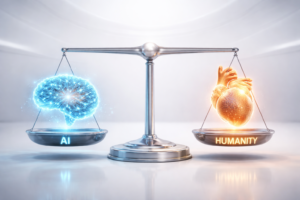
It’s not all utopia, however. As a techie myself, I’m an optimist, but we have to examine the scoreboard, you know.
The Advantages (Why We Love It)
-
Elimination of Drudgery: AI Systems perform the unimaginative tasks of data entry, scheduling, calculating taxes. People are left to be imaginative.
-
24/7 Availability: Your AI assistant never gets tired, ill, or burned-out.
-
Superhuman Accuracy: In domains such as radiology or Structural engineering, AI systems are less likely to go wrong than human experts even when those experts are the best in their field.
-
Accessibility: AI assists the blind to “see” through description applications while deaf individuals can communicate through sign language translation.
The Limitations (The 2026 Headaches)
-
The “Black Box” Problem: Deep Learning models are normally so complex that often the developers also do not know through which process they reached a certain answer. It makes it difficult to ascribe trust when decisions are made based on legal or medical matters.
-
Hallucinations: Yes, even in 2026, sometimes AI will confidence lie. It may invent a court case or a historical fact. We call this “hallucination,” and it’s why human oversight is still mandatory.
-
Data Privacy & Sovereignty: If AI knows everything about you to help you, then it knows everything about you. Who does this data belong to? You, or the corporation that’s training the model? This is going to be the most gigantic legal battle of our decade.
-
Empathy Deficit: Artificial intelligence might assess your tone, but it can’t feel your pain. There’s a “coldness” to synthetic interaction that will be recoiled from by humans eventually.
Conclusion: The Era of Co-Intelligence
What, then, is Artificial Intelligence?
In 2026, AI isn’t something you opt to use. It is the infrastructure of our world: the invisible partner in your pocket, the safety net in your car, and the organizer of your work.
We are entering an era of Co-Intelligence. The future is not that AI replaces human beings; it’s about humans who use AI replacing those who don’t. The “Us vs. Them” mentality is fading. Now, it is about how well you can dance with the algorithm.
Fear not the machine; instead, learn to speak its language. In this new world, your ability to direct intelligence is more valuable than your ability to remember the facts.
Be curious.