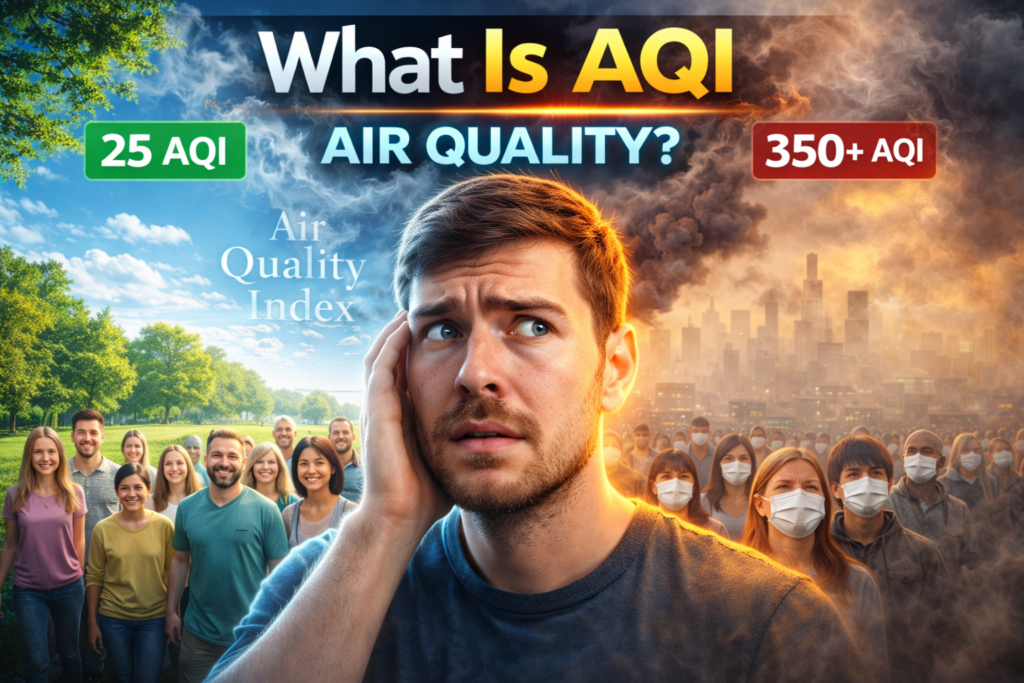
What Is AQI? Air Quality Index & Health Impact Explained
By Naman | Air Quality Index | January 22, 2026
Can you raise your hand if checking the air quality app has become an everyday task, like checking the weather?
I recall when my wife and I barely bothered to check those numbers in 2020, unless the sky seemed like something out of a doomsday flick. Cut to 2026, and things are no longer the same. With the smog conditions in the West due to the forest fires, and the pollution alerts in major cities, the Air Quality Index is no longer a number but the determining criterion on whether we go out to the park with the kids or stay indoors with the air purifier running on Turbo. But leave aside that number that’s flashing on your smart wrist device for now! What does that number even represent? When the Air Quality Index is 115, does that number translate to “okay” for a jog, or is it
Okay, let’s take a closer look at what exactly AQI is, how it is measured, and what is, quite obviously, the crucial part of all of this: protecting your lungs in today’s world.
What Is AQI? (The Simple Explanation)
Think of the Air Quality Index (AQI) as a thermometer for the air.
Just like the thermometer tells whether it is hot or cold, the AQI tells whether the air is clean or polluted. It is a standardized means of communication of the health hazard level of the outdoor air. This is conducted by a government agency such as the EPA in the United States or the CPCB in India.
The scale range is normally from 0 to 500.
- Lower numbers (0-50): The air is fresh and clean. Take a deep breath.
- Higher numbers (300+): The air is dangerous. It is, in effect, “emergency” conditions.
What is it actually measuring?
AQI is not singular. It is a combination of major pollutants. In 2026, the monitors measure five major pollutants:
- Ground-level Ozone (O3): The main ingredient in smog.
- Particle Pollution (PM2.5 and PM10): This is the big baddie (more on this later).
- Carbon Monoxide (CO)
- Sulfur Dioxide (SO2)
- Nitrogen Dioxide (NO2)
So when you see that your AQI is 150, it means that it is calculating the level of these pollutants for some period of time (usually 24 hours), then it shows you the worst one, which in most cases is PM2.5.
Why PM2.5 Matters: PM2.5 is a designation for particulates smaller than 2.5 micrometers. To give you a better idea, the average width of a human hair is 70 micrometers. PM2.5 is small enough to sneak past the nose hairs, into the lungs, and into the bloodstream. That’s why we consider it such a problem.
The AQI Scale & Color Codes
If there’s one thing that you’ll remember from this guidebook, let it be this color palette below. This is what most apps use when it comes to these colors to facilitate quick responses.
| AQI Value | Color Code | Meaning | Who is at Risk? |
| 0 – 50 | 🟢 Green | Good | No one. Enjoy the outdoors! |
| 51 – 100 | 🟡 Yellow | Moderate | unusually sensitive people (rare asthma cases). |
| 101 – 150 | 🟠 Orange | Unhealthy for Sensitive Groups | Kids, seniors, and those with asthma/heart issues. |
| 151 – 200 | 🔴 Red | Unhealthy | Everyone. You might feel “heavy” breathing. |
| 201 – 300 | 🟣 Purple | Very Unhealthy | Health alert. Avoid outdoor exertion. |
| 301 – 500 | 🟤 Maroon | Hazardous | Emergency conditions. Stay indoors. |
Pro Tip: In 2026, many of us have our own “personal” threshold levels. Then, if you have allergies, you could begin feeling the effects in the Yellow (Moderate) region, despite what your national government finds acceptable.
How Poor AQI Affects Your Health
My thinking was, “I’m fine if I don’t cough,” and that was a very big mistake for me.
The problem with bad air quality is that the consequences are often invisible. It’s more than just coughing this week. It’s heart health in 10 years.
Short-Term Effects (The “Right Now” Symptoms)
At a trigger level of that Red (150+) zone of AQI, even a healthy individual can feel:
- Sore, irritated eyes, nose, and throat (scratchy sensation).
- Shortness of breath during exercise.
- Headaches or fatigue.
- Reduced lung function: Actually, it becomes more difficult to take a deep breath.
Long-Term Effects (The Silent Killers)
Long periods of high AQI (which has become common in most urban areas today) have been associated with serious problems that include:
- Respiratory Disease: Exacerbated asthma and chronic bronchitis.
- Heart Problems: PM2.5 leads to inflammation of the blood vessels, thus increasing the chances of a heart attack or stroke.
- Cognitive Decline: Recent studies in the mid-2020s have found correlations between cognitive decline and the effect of air pollution on the mind, specifically relating to memory and concentration.
Safe AQI Levels for Humans: What’s the Magic Number?
This is where it gets tricky.
The WHO sets very strict standards—far stricter than most cities are capable of meeting. The ideally desired level of AQI would be below 50.
Nevertheless, in a busy city like this one, a yearly AQI below 50 is not easy to maintain.
- The “Realistic” Safe Zone: For healthy individuals, an AQI value of 0 to 100 is regarded to be within the safe range.
- The “Caution” Zone: After crossing 100, if you are jogging, biking, or doing heavy labor, you are breathing in a lot more pollutants because your rate of breathing increases.
My Rule of Thumb: When the AQI exceeds 150, the run outside turns into a treadmill run inside. It’s simply not worth the exchange.
Daily Precautions for High AQI (2026 Edition)
Currently, we are in a better technology period than five years ago. This is how you can protect yourself with technology when the air in your surroundings becomes toxic.

1. Control your smart home
Today, we all probably already have a smart thermostat in our homes. Just make sure your home is equipped with a smart connection between your heating and cooling systems and an air quality sensor inside your home. For 2026, a good air purifier is no longer a luxury item Action: Turn on your purifier and set it to “Auto.” Your purifier will sense any sharp rise in your indoor PM2.5 level, such as through cooking or opening a window, and automatically speed up its fan speed accordingly.
2. The N95 is Still King
Fashion accessories are cloth masks, which do not contribute anything to filtering PM2.5.
When the AQI reading goes above 200 and you have no other option but to go out, you should wear an N95 or an N99 mask.
Make sure the straps on the mask are comfortable, as this will ensure you wear them regularly.
3. Timing is Everything
Pollution levels can also vary. Indeed, for many urban areas, air quality is at its worst in early morning hours, owing to temperature inversion, and at its best in mid-afternoon.
Action: Before undertaking your walk, check the “hourly forecast” of your air app.
4. Recirculate Your Car Air
This is a no-brainer rookie move. To prevent this when driving through a smog area, simply press the Recirculate Button on your car’s AC system when driving through a smog area to prevent your car from inhaling dirty air from in front of your truck and to clean the air out of your car.
Conclusion: Don’t Panic, Just Prepare
Air quality is a reality that we cannot and shall not ignore, yet must not live in fear of either. The operative word here is awareness, not fear.
These are the kinds of things that you have to consider in this modern age where you have access to information right in your pocket. Take advantage of it. If the AQI is high, close the windows, switch to the air purifier, forgo your park time for a day. Your lungs work hard for you; give them a break.
Remain safe and healthy. Breathe clean. Watch the numbers.
Frequently Asked Questions (FAQ)
Q: Can I go out to exercise if my AQI value is 150?
A: It’s not recommended. The reason is that when you are physically active, you start breathing heavier, which means you are bringing higher amounts of air pollutants deep inside your respiratory system. The AQI value should not be above 150 (Unhealthy). You should do indoor exercises instead.
Q: Does rainfall help to improve AQI?
A: Yes, it does! Rain helps to clean out pollutants in the atmosphere. Rain acts like a natural “scrubber” in the atmosphere. It helps to remove particulate matters (both PM2.5 & PM10) from the atmosphere. This results in a drastic reduction in the AQI reading.
Q: What is the difference between PM2.5 and PM10?
A: Size is the only difference between the two. Particles in PM10 are small, similar to dust or pollen, and may cause irritation in your eyes or nose. Particles in PM2.5 are very small, such as combustion particles and organic compounds, and are much hazardous because they easily reach the lungs and blood.