

Top Mobile Games That Will Shape the Future
Do you remember when “Top mobile games” meant black and white snakes or tapping birds on pigs? It’s almost a lifetime ago. Welcome to 2026. The thing in your pocket today is capable of incomprehensible processing power, likely more processing horsepower than gaming consoles from the last ten years combined.
Gone are the days when “mobile” referred to watered-down experiences. What we’re seeing today is not just the shrink-down-and-port console experience but the creation of experiences from the ground up and taking advantage of new features only found on mobile, such as high-powered scanning via LiDAR, on-device AI processing capabilities, and even 6G connectivity. Gone are the days of casual time-wasters; we’re talking about building massive worlds that we can carry around everywhere with us.
Being an entertainment writer and being so involved in this industry, I have been monitoring the titles which are doing something more than just being at the top of the download charts. These games are the ones that change the manner in which we play digital entertainment.
Below are the top 5 mobile games that are setting the course of the future in this technological innovation.
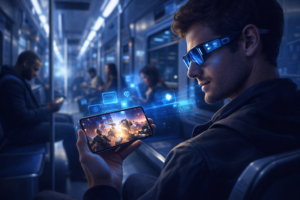
1. ChronoWeave AR: Redefining Reality
Through the early 2020s, Augmented Reality had gotten off to a rocky start: too often gimmicky, or outright not working well out of doors. That started to change this year, with the launch of ChronoWeave AR. This isn’t about overlaying cartoon characters onto your living room floor.
ChronoWeave AR leverages advanced sensor suites within contemporary smartphones and smart glasses that layer historical data onto the real world in real time. Just picture yourself treading downtown Rome and seeing an accurate, AI-generated overlay of how the Roman Forum stood two thousand years ago, replete with digital citizens going about their day.
Gameplay involves the solving of historical mysteries by physically moving between the present and the past at specific geographical locations. It’s turned city streets into huge game boards. This title proves that the future of top mobile games lies in getting players off the couch and engaging with their physical environment in meaningful ways. It’s educational, deeply immersive, and showcases the true potential of spatial computing.
2. Vanguard Zero: The Esports Titan Built for Viral Fame
We can never talk about the future of entertainment without bringing into the conversation the role of short video platforms. This is because either the likes of TikTok or its successors are responsible for setting the current cultural trends. Vanguard Zero represents the first serious competitive shooting game created with a “clip culture” in mind.
Even if it is essentially a 5v5 shooter, the part where the game uses its engine is genius. The game has the feature to automate the buffering of the last thirty seconds of gameplay. Just one touch is needed after achieving a good double kill, and the game will use the AI of the device to instantly edit the vertical highlight video, complete with beat-synced music.
This cross-pollination has resulted in the massive popularity that *Vanguard Zero* has. This is because the game makes everyone who participates in it a content creator. This is a design consideration that acknowledges that in the year 2026, the ‘viewer’ is just as important a consideration as the ‘player.’ This is the design ethos that all future games should strive towards.
3. Starfall Exodus: The Death of the “Mobile Version”
For so long, it had been the “real game” on PC/Console, and the “mobile version” typically a shadow of the former. That notion is laid to rest with Starfall Exodus.
This enormous sci-fi MMORPG has one game engine that works on all devices seamlessly. If you are playing the game from your powerful computer system in the house, you will be able to see 8K textures and ray tracing. But if you leave the house to go to work and play from your mobile device, trust me, you will be inside the same world, same character, same boss fight with PC gamers.
“The graphical fidelity on the phone is astounding, thanks largely to the heavy lifting being carried out by cloud-assisted rendering.” This is how a gaming expert summed up the Starfall Exodus experience, which clearly demonstrated the fact that the hardware being used is only a gateway into the world, but not a determinant of the gaming world itself.
4. Project: Mnemosyne and the Rise of AI NPCs
In mobile narrative games, the only way to include storytelling through the game was through text overlays in choose-your-own adventures or cutscenes. However, with the release of Project: Mnemosyne, which is a neo-noir detective thriller, all of that changed through the implementation of sophisticated Large Language Models (LLMs) in the game’s non-player characters (NPCs).
In this game, there will be no dialogue trees. You will be typing (or using voice-to-text functions, if available) the questions you would like to ask the suspects. The NPCs will assess these entries, forming a response based on the character description and temperament, as well as the evidence they have been exposed to.
There is no guide that you could search for, because each pair of interrogations is different. It has the feel of being profoundly human, often uncomfortably realistic. The use of generative AI is creating game worlds that had been static, reactive, and is raising the bar for handheld devices.
5. TerraForm Tycoon: Utilizing Global Cooperation
While most games are about individual accomplishments or small team play, TerraForm Tycoon is actually capitalizing on the power of global connectivity for its massive cooperative endeavor. It’s a deeply intricate strategy simulation concerning terraforming an uninhabitable planet, but it all occurs on one continuously connected server with millions of users.
While your own play may relate to developing a localized oxygen scrubber or running a small mining outpost, it seems insignificant, but it is actually contributing to a real-time worldwide system that has a real effect on a worldwide atmosphere for everyone else that is playing. The game involves enormous amounts of real-time coordination that spans time zones and language differences made possible through real-time translation within the game system itself.
It is also interesting to consider the extent to which this is both a game and social experiment. It reveals the potential of mobile technology, given the natural interconnectedness associated with such technology, in pursuing global cooperation within the field of game environments. Players feel they are part of one cause.
Conclusion
Looking at these five titles, it’s pretty clear that the era of the “time-killer” mobile game is well and truly done. The most popular mobile games of 2026 command your undivided attention, collapse the division between the digital and natural worlds, and make restantial use of advanced AI to create deeply personal experiences.
We are not just tapping screens anymore; we are stepping into alternate realities on our lunch break. The tech has finally caught up with the ambition, and for gamers, there has never been a more thrilling time to have a supercomputer in your pocket. Keep your eyes peeled, because the next paradigm shift is probably already downloading to your home screen.