
Microlearning Trend: Build Skills in 30 Minutes Daily
By Naman | Part-time Trader | Microlearning Trend = Speed Learning
In trading, we have a technique known as “scalping.” Rather than waiting for weeks for a dramatic change in the market to make money, you make small, frequent trades that cumulatively lead to huge profits at the end of the day. It is a low-risk, high-frequency activity that demands high focus.
The education market in 2026 is acting exactly the same way. The days of the “buy and hold” diploma—where you attend for four years and then hope it holds value for forty—are finished. The market is moving too quickly. Skills are depreciating faster than a new car on the market.
The Microlearning Trend Arrives.
As a disciplined professional who has to manage a trading portfolio as well as a career, I consider time to be my scarcest resource. I do not have the luxury of disappearing into a lecture hall for three hours. However, I do have the luxury of 30 minutes. If you treat learning like dollar cost averaging, where you invest small sums of money at regular intervals, you will create a huge competitive advantage.
It’s not just about learning from TikTok videos. It’s a systematic, scientific way of upskilling that fills in the blanks of a busy schedule. Here’s how you can leverage microlearning to compound your value in 2026.
What Is Microlearning?
Micro-learning is the act of consuming learning content in small, focused chunks that are usually 3 to 15 minutes in length. While a typical university course is designed to teach you “Economics,” a micro-learning module is designed to teach you “How to read a Balance Sheet” or “How to calculate Moving Averages.”
It targets one learning objective. In financial terms, it is “pure alpha”—it removes the fluff (beta) and gives you only the information you need to act on right now.
In 2026, this format is the norm because our attention economy requires it. We are flooded with data. Our cognitive capacity is at maximum capacity. Microlearning recognizes your bandwidth. It recognizes that you are a new student or professional who must apply a skill today, not next semester.
Why Short Learning Works: The ROI of Attention
You could ask: “Can you really learn anything complex in 10 minutes?”
The solution is in the “Forgetting Curve.” Studies have shown that people forget 50% of new information in the first hour if they don’t use it. The traditional method of learning, which involves a lot of information, overloads the brain, resulting in diminishing returns.
Microlearning is optimized for retention.
- High Engagement: It is easier to remain 100% engaged for 10 minutes than 70% engaged for an hour.
- Immediate Application: You learn a particular formula in Excel in 5 minutes and apply it immediately. The “lag time” between learning and application is zero.
- Agility: In trading, if a system fails, I abandon it right away. If a microlearning tool becomes outdated, you haven’t wasted six months learning it. You simply move on to the next lesson.
For a side hustler or a trader, this is very important. I don’t want the history of the stock market; I want to know how to do an options trade on the current system. Microlearning provides the “how-to” without the history lesson.
Best Microlearning Platforms in 2026
Just as I select my brokerage firm for execution speed and low costs, I select my learning platforms for content density and user experience.
1. Blinkist / Headway (For Concepts)
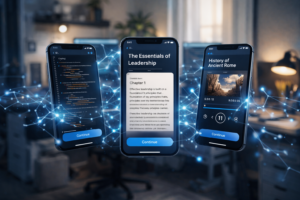
These tools have developed beyond mere book summaries. In 2026, they provide “Audio Masterclasses” that are in-depth explorations of difficult subjects such as negotiation, behavioral economics, or crypto regulations, lasting 15 minutes. I listen to these while I run in the morning. It’s “net time” (No Extra Time) learning.
2. SoloLearn / Mimo (For Coding)
If you want to learn Python or Solidity (for smart contracts), you don’t need a boot camp. These apps turn learning into a game. You write code snippets on your phone while waiting for your coffee. It keeps the syntax fresh in your mind, which is important for coding literacy.
3. LinkedIn Learning “Nano-Tips”
made a sharp turn into this kind of content. Their “Nano-Tips” series features 2-minute videos from experts in the field. It’s ideal for soft skills training: leadership, conflict resolution, or time management tips. It’s professional development without the tedium.
4. TikTok / YouTube Shorts (The Wildcard)
4. TikTok / YouTube Shorts (The Wildcard)
Yes, social media matters, but only if you manage your feed. I have a second account that is strictly for educational content creators—Excel gurus, market analysts, and AI prompt writers. If I log into that account, I learn. If I log into my personal account, I waste time.
Skills You Can Learn Fast (High-Value Targets)
If you have 30 minutes a day, don’t spend it on low-value skills. In trading, we seek “asymmetric upside.” What skill will take 30 minutes to learn but will save me 10 hours a week?
1. Advanced AI Prompting
You don’t have to have a degree in computer science to be great at Large Language Models. Take 15 minutes a day to experiment with new prompts. Learn how to do a chain-of-thought prompt. Learn how to get the AI to debug code. This is the most high-leverage skill in 2026.
2. Financial Literacy & Technical Analysis
You can learn one chart pattern (such as “Head and Shoulders” or “Bull Flag”) in 10 minutes. You can learn one financial ratio (such as P/E ratio) in 5 minutes. In one year, that is 365 financial concepts. You will know more than most bank managers.
3. Keyboard Shortcuts & Speed Reading
It sounds boring, but efficiency is wealth. If you learn the shortcuts for your main tools (Excel, VS Code, Notion), you will increase your efficiency by 20%. That is pure profit in terms of time saved.
4. A Second Language (Business Fluency)
You will not become a poet, but you can be conversational. 30 minutes of Duolingo or a similar AI tutor app per day is sufficient to deal with basic business emails or greetings in Mandarin or Spanish. In today’s global economy, this rapport is an asset.
Microlearning vs. Long Courses
Do you cancel your university degree? Not necessarily. It is about asset allocation.
Long Courses : These form the basis. Deep theory, structural knowledge, and credentials. They are slow, stable, and required for certified professions such as law or medicine.
Microlearning : These are what provide the growth. They keep you relevant. They enable you to pivot.
Use Microlearning when:
- You have a problem to solve at this moment.
- The subject matter keeps shifting rapidly (for instance, Social Media Algorithms, AI Tools).
- You are discovering a new area of study to determine if you enjoy it.
Use Long Courses when:
- You require a paradigm shift in your career.
- You require a recognized license or certification.
- You seek a deep, philosophical insight into a topic.
For the modern student, the approach is a hybrid. Use your degree for the foundation, but use microlearning for the actual marketable skills that get you hired.
Conclusion
The most successful traders are the ones who are present every single day. They do not attempt to hit a home run every morning; they simply attempt to be slightly profitable.
Micro-learning is the same field. It eliminates the “I don’t have time” excuse. Everyone has 30 minutes. You have 30 minutes on the train. You have 30 minutes before bed. You have 30 minutes waiting for a meeting to start.
If you take that “dead time” and put it into micro-skills, the compound interest is staggering. In one year, you haven’t just learned one thing; you’ve upgraded your whole operating system.
In 2026, the divide between the successful and the struggling is not intelligence—it’s adaptability. Microlearning is the key that keeps you agile, quick, and profitable. Start your 30-minute timer today.