From TikTok to Netflix: Biggest Entertainment Trends of 2026
But if it seems like the state of the entertainment trends world is constantly changing when you open your phone, then you’re definitely not alone with these feelings either. First of all, we’re sitting in the early part of the year 2026, and the world of media consumption has undergone a shift and a half since the last five years alone. The lines that once existed, differentiating someone scrolling through a video on their commute versus someone watching a two-hour movie on a Friday night, have basically been erased at this point.
Today, entertainment is more than just what’s being viewed, and the viewing experience itself and the creators becoming more important factors. The big studios are no longer just trying to compete with each other but also trying to compete with a nineteen-year-old in their basement and a high-end camera and a million fans that love what he or she does.
As an entertainment journalist, I have watched many changes over the years, but this is an absolute converge. What is happening is that short-form video is calling all the shots in long-form shows, while game mechanics have crept into awarding-winning television shows.
In order to determine the direction in which we’re heading in the current year, it’s necessary to examine the major influencing factors on our screens. Below are the most defining elements in the realm of entertainment in the year 2026.
The Relentless Reign of Short-Form Video
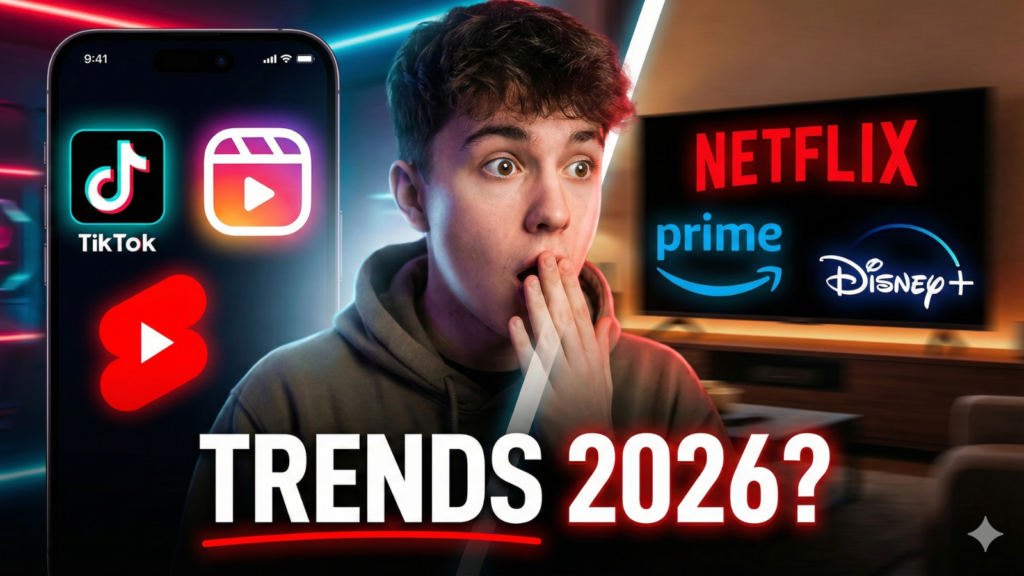
It’s amazing how longer ago, people actually thought TikTok was a phase that would eventually pass, a little dancing fad for teenagers. Ah, ancient history. Now, in 2026, TikTok, Instagram Reels, and YouTube Shorts are responsible for the leading cultural engine driving this entire industry.
The New Search Engine
For audiences under thirty, these platforms have largely become the default means of discovery over traditional search. People aren’t Googling “best new sci-fi movies.” They’re searching their “For You” page for clips, reviews, and aesthetic edits that vibe with their tastes. If a movie or show doesn’t have a digestible, shareable footprint on short-form video, it practically doesn’t exist to a massive demographic.
The Explosion of “Micro-Series”
But the most interesting development this year is the maturation of the “micro-series.” We’re getting high-production value, serialized narrative told in its entirety in sixty-second chunks. These aren’t just amateur skits anymore. Major production companies are financing narrative arcs designed to be consumed in the time it takes to wait for an elevator. It turns out you can create some compelling character development in minute-long bursts if the writing is sharp enough. This format has trained audiences to want immediate hooks and constant narrative progression, a trend that is bleeding over into how traditional TV pilots are written.
Streaming Services Fight Back with Immersion
The streaming wars that raged through the early years of the 2020s are now a détente. They have a market that is just plain flooded, and the phenomenon of “subscription fatigue” is all too real. And recognising this, the big heavy hitters like Netflix, Disney+, and HBO Max have had the awakening that it takes more than having a massive catalog.
The Rise of “Lean-In” Content
One of the largest changes of 2026 in the area of internet streaming is the focus on interactivity. We are now well past the experimentation stages of Black Mirror: Bandersnatch. It’s time for interactivity in certain types of genres.
TV game shows now often involve home viewers voting in real-time to influence the outcome. TV mystery shows now allow you to analyze clues in a scene using the remote or increasingly with AR glasses while the conversation is ongoing. Streaming platforms are doing everything possible to make TV watching an active process in order to retain your loyalty and engagement.
Franchise Fatigue vs. Original Swings
Though franchises are still majorly leading in terms of grossing revenues, their audiences in the year 2026 are beginning to show signs of exhaustion with spin-offs, spin-offs, and even more spin-offs. The major successes in streaming this year have consisted of original and slightly odd ideas that just don’t need viewers to understand thirty films that came before them in order to make sense.
The Convergence of Gaming and Passive Viewing
Ask any person under the age of twenty-five what their prime source of entertainment is, and they will not say “watching TV.” They will say “gaming.” This is what the industry realizes, and the difference between a video game and a film has never been more blurred.
AR/VR Finally Hits Mainstream
It’s taken years of false starts and clunky headset designs, but the year 2026 marks a point when augmented and mixed reality technologies began to feel more comfortable in their contemporary format to the average consumer’s hands and head. Advances in hardware from leading technology companies mean that entertainment is leaving the television screen behind.
We’re experiencing the „spatial narratives„, where characters from your favorite TV program appear to exist in your living room using AR. Gone are the days when you blocked out the world using the heavy VR helmet, and it’s all about overlaying entertainment in your actual world. This technology is very costly, but this is the fastest-growing category in the entertainment market.
Gamified Media
Why simply binge-watch the series when one could redeem points for viewing the series? Online streaming platforms tend to incorporate the gamification of experience to a large extent. It’s not about the mere time one spends in the series. It could be unlocking the behind-the-scenes footage, digital art, or even discounts on the merchandise based on the completion of the “quests” associated with the series one chooses to watch.
Global Fandoms and the Creator Economy
The final gigantic trend would relate to the complete and utter decentralization of power within Hollywood circles. They have lost the keys to the gate.
Creators as Studios
The Creator Economy has come of age. Today, “top-tier” creators are more than just “influencers.” They have, in fact, become full-fledged media houses, functionning with budgets that could compete with those of “cable networks.”
In 2026, a independent filmmaker’s documentary series on YouTube can easily draw bigger numbers for viewership than a primetime network special. This is because audiences tend to believe in individuals in the industry more so than corporations.
The Power of Hyper-Niche Fandoms
Mainstream is out, but niche is in. The web enables the existence of very niche audiences. You don’t need to make TV that 100 million people mostly like. You need to make TV that 5 million people love. These hyper-niche fan groups are the ultimate currency in the industry. They drive the merchandise sales, create the fan art, and distribute the free publicity that keeps the engine running. The studios are putting fewer resources into trying to appeal to the masses and are instead trying to tap into these subcultures.
Conclusion
“The trends in the world of entertainment in the year 2026 are all about the need for “agency,” asserts writer Caleb Maddux. “Consumers no longer want to be passive recipients of the content,” he explains. This could be in terms of choosing the perspective of a sports video, engaging with a YouTuber in a chat, or immersing oneself in an AR environment.”
In my opinion, the industry feels rather daunting at the moment. There’s far too much to consume and far too many platforms competing for your credit card number. My take? Simply refuse to keep up. Find what speaks to you, appreciate the innovations that improve your experience, and shun the rest. Great entertainment should invigorate you, not fatigue you.