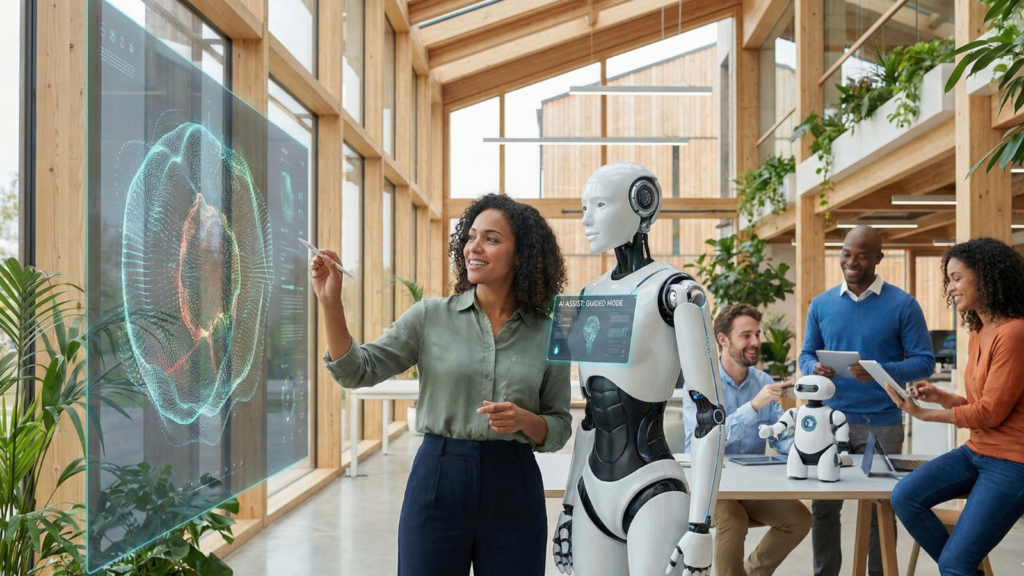
Introduction : Can AI Replace Humans
In 2026, “Artificial Intelligence has moved beyond the experimental stage. It can compose and send e-mails, generate graphic images, analyze financial information, answer consumer support questions, aid physicians, and enable programmers to code faster.” Of course, this kind of rapid advance would ultimately lead to the big and emotional question of
Can AI replace humans?
The issue matters because it quite literally impacts careers, education, creativity, business, and human relevance. Every technological revolution, from the arrival of machines to the coming of the computer and the internet, brought with it worries about losing human relevance or being made redundant by the technology. It feels different with AI because it deals with “thought,” something that, until now, has always been the domain of the human being.
But the truth lies not in fear or in hype. To grasp what the future of work looks like, we need to distinguish between fact and fiction when it comes to AI.
As someone intrigued with AI technology, automation, and human intelligence, the one thing that isn’t on the table is replacement.
Understanding Artificial Intelligence in Simple Terms
But before explaining whether AI can replace humans, an important understanding of what AI actually is — and what it isn’t — has to be carved out.
Artificial intelligence is systems designed to perform tasks that normally require human intelligence, such as the learning of patterns, making predictions, or automation of decisions.
Active systems depend on:
- Machine learning models
- Large datasets
- Predefined goals
- Computing power
AI does not think independently, nor does it have emotions, self-awareness, or personal intent. It operates within boundaries set by humans.
This is the critical difference when discussing AI versus human intelligence.
Can AI Replace Humans? The Short Answer
AI can replace tasks. Not humans.
AI excels at the identification of steps in multistep approaches.
- Speed
- Scale
- Pattern recognition
- Consistency
Humans excel at
- Creativity
- Emotional understanding
- Ethical judgment
- Contextual reasoning
- Decision based on purpose.
The future of work is not about replacement, it’s about role redefinition.
Where AI Is Already Replacing Human Tasks
Let’s begin with facts and not hypotheses or guesses about the future. The reality is that AI is already changing how work is done.
What Work the AI Is Displacing Today
- Data Entry Repeating
- General customer service questions
- Routine data analysis
- Content Summarization
- Quality checks & monitoring
The effect of this automation can be seen in all sectors, ranging from the financial sector to marketing and the manufacturing sector.
But the important point is: These are job tasks, not occupations themselves.
Jobs AI Is Transforming (Not Eliminating)
Rather than going away, many roles are changing.
Examples of Transformation Result of Transformation
- It is nowadays used in marketing to provide insights and not to act as a replacement in strategies
- The designers rely on the use of AI technology, though they determine the creative direction
- Developers use AI in their coding, not for developing system architecture
- More emphasis is laid upon interpretation than upon data processing.
AI moves humans up the value chain and not out of the chain.
The Biggest Myths About AI Replacing Humans
Myth 1: AI Will Take All Jobs
Reality:
Every major technology introduced new job categories. AI will be no different
New Roles Already Emerging:
- Machine learning trainers
- Encourage engineers
- AI ethics experts
- Robot Analyst
- Human AI workflow designers
The future of work is evolving, not ending.
Myth 2: AI Is Smarter Than Humans
Reality:
It is faster, not smarter.
AI doesn’t have
- Emotional intelligence
- Ethical reasoning
- Conscious awareness
Conscious awareness It can process data extremely well, but the comprehension of meaning is human.
Myth 3: AI Creativity Equals Human Creativity
Reality:
It works based on the patterns created.
Human Creativity:
- Originates from emotion
- Is driven by purpose
- Patterns deliberately broken
Thus, human creativity versus AI becomes a partnership, not a competition.
The Real Risk: Ignoring AI, Not AI Itself
The worst risk isn’t about replacing human beings.
The actual risk is:
- Upgrades for skill
-
Ignoring AI evolution
- Skipping technological literacy
Inability to adapt may result in feeling replaced—not by AI but by humans enabled with AI.
Who Really Wins the AI vs Human Debate?
So, can AI replace humans?
No — but it will redefine what it means to be human.
Ai Can :
- Handle scale
- Enhance efficiency
- Make less mistakes.
Humans will:
- Set direction
- Define the values of
- Encourage creativity
- Ethical decision making
The future will belong to those human beings who can understand the meaning of artificial intelligence, rather than fear it.
Conclusion: A Human-First, AI-Assisted Future
In 2026 and beyond, AI is not the enemy or a savior. AI is a tool. A very powerful tool.
The future of work will be driven by:
- Intelligence of Human
- Machine Learning
- Collaborative efforts by both parties
Those who adopt this balanced approach will be the leaders of the future wave of innovation.
The development of the AI is not over yet.
Human intelligence must develop along with it – deliberately, responsibly, and creatively. That is the true future of working.