Apple vs OpenAI vs Google: AI War in Smartphones
By Naman | AI War in Smartphones | January 22, 2026
If you purchased a high-end smartphone in 2024, you purchased a device to run applications. Today, in 2026, if you purchase a smartphone, you purchase a device that is an app—one massive, smart, and self-corrective application driven by AI.
The age of the “App Store” is rapidly nearing an end. What I’m watching is the intentions of a ruthless, high-stakes battle for the very soul of the smartphone experience. It is now much more than which has the best camera, the best screen brightness. It is who controls the “Intelligence Layer.”
The combatants? Apple (the ecosystem leader), Google (the data behemoth), or OpenAI (the upstart).
Each has a drastically different plan for the supercomputer in your pocket. Okay, now let’s break down the battle-scarred landscape.
Why Smartphones Are Now AI Devices
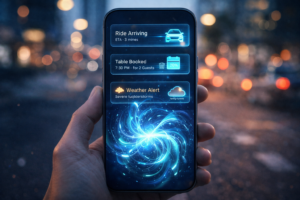
For a decade, we lived in the “App Economy.” You wanted a ride? You opened Uber. You wanted dinner? You opened DoorDash. You acted as the manual switchboard operator, jumping between silos.
In 2026, the AI Agent mans the switchboard.
Today’s smartphones are “Intent-first” devices. You don’t tap icons anymore; you say what you want. “Book a table for two at an Italian place near the cinema and order a ride to get us there by 7 PM.”
The phone doesn’t just search; it executes. It negotiates with the restaurant’s booking API, checks traffic patterns, and hails the car. This shift from User-Driven to Agent-Driven computing is why the hardware makers and model builders are fighting. Whoever owns the agent owns the customer.
Apple’s AI Strategy: The Privacy Fortress
Apple enters the Generative AI scene quite late, but, as usual, they hope to be the ones who dress up the party best.
Through deeply integrating Apple Intelligence into iOS 19, Apple hasn’t attempted to create a model that is “smartest” in an IQ test sense but rather built an extremely integrated model.
The ‘Siri Reborn’ Play
Siri isn’t the laughing stock of the tech industry anymore. It’s now an orchestration layer. The humongous advantage that Apple has is through “App Intent”. They own the OS, and therefore Siri can access third-party apps and do the task.
Plus: On-Device Privacy : Apple mainly processes their requests on their Neural Engine. For those petrified users in 2026 worried about their data being used to train a cloud model, Apple is the haven or haven’t yet found their haven yet.
Minus: Siri is Not Weakness: It’s still a “Walled Garden.” It all integrates wonderfully if you’re using all of their software. If you’re in the Google Workspace world or use off-the-behnel tools, the friction then kicks in. Apple Intelligence is really smart if you’re just inside
OpenAI’s Mobile Ambitions: The Ghost in the Machine
OpenAI is the wild card. They have no phone OS offering—yet—but they have the brains to match the brightest human brain.
The ‘Super App’ Strategy
The chatbot app in 2026 is not only a chatbot but an overlay. It already has the capability to run the screen permissions to function as an all-in-one assistant on Android phones. For Apple phones, it challenges Apple’s restrictions. The aim of OpenAI is to disregard the OS entirely. They want you to exist within their environment, treating your iPhone or Pixel as nothing more than a dumb screen.
The “Hardware” Pivot (Project Sweetpea)
The news that Jony Ive X OpenAI are indeed partnering has been finalized. The plan isn’t to replace the iPhone right away but to “unbundled” it instead. The forthcoming product from them, which will come in late 2026 and will be screenless, predicts that ambient voice computing is the future instead.
Strength: Raw Intelligence. GPT-6 or its modern version is far ahead of Siri and the Gemini Nano when it comes to complex reasoning and coding problems.
Weakness: Hardware Experience. Hardware is difficult to work with. Ask Humane or Rabbit people. OpenAI will need to show that it can develop
Google AI Ecosystem: The All-Knowing OS
Multimodal Dominance
Who Will Win the AI Smartphone War?
The “winner” depends on what you value most as a user.
1. The “Ease of Use” Winner: Google
If you want a phone that can magically organize everything for you in life and you’re willing to give up a bit of privacy for the benefit, the combination of Android + Gemini is unstoppable. It’s the smartest assistant for a typical consumer.
2. The “Privacy” Winner: Apple
Apple Apple will keep the premium segment. Experts and Pruitts will remain loyal to the iPhone because they can enjoy the “good enough” AI experience from Apple Intelligence while not feeling under constant observation.
3. The “Power User” Winner: OpenAI
OpenAI “OpenAI will own the workflow of creators, coders, and thinkers. Just think: even if they own an iPhone, their home screen will be just the icon for the ChatGPT application.”
Frequently Asked Questions (FAQ)
Q: Will AI use more battery in a 2026 phone?
A: Actually, the opposite is starting to happen. While AI tasks are intensive, the new NPU chips inside iPhone 17 and Pixel 10 are designed specifically for these bursts of computation. Instead of constantly pinging a cloud server over 5G, tasks are processed locally, and we have seen better battery efficiency for everyday use than 2024 models.
Q: Meanwhile, can’t I just disable the AI and use my phone as a regular phone?
A: For the time being, yes. Apple and Google do offer an “Classic” or “Low-Data” mode that turns off the predictive agents. At some point, though, as third-party apps cease building traditional menus and depend on AI Intents to function, using a “dumb” phone will become increasingly difficult when attempting to use it for modern tasks such as banking or planning a trip.
Q: Is it building a phone?
A: Not in the sense of building a device that has a screen grid. Their deal with Jony Ive and LoveFrom appears to be more of a “companion device,” which would be a wearable electronics device that listens to everything you do, presumably attaches to your smartphone, but could function in the cloud. It would be an always-on smart device that listens to you and observes you.