Introduction: Why the AI vs Human Intelligence Debate Matters Today
In 2026, AI is neither an abstract notion nor something being tested in a lab somewhere. AI creates content, interprets data, synthesizes images, drives cars, responds to customer inquiries, and supports doctors and engineers. Yet, humans continue to invent, create, show empathy, and make complex decisions that shape society. AI vs Human Intelligence
It is a fact that has brought a big question to the fore:
AI Vs Human Intelligence: Who will really rule the future?
This debate thus comes to reshape the way we work, learn, create, or even define human value. What is required, instead, is a balanced and analytic understanding of what AI can do, what humans do best, and how both will coexist.
This subject is fascinating, and as someone excited by AI tools, automation, and human intelligence, this is not a story about the competition; it is about evolution.
Understanding AI and Human Intelligence
What Is Artificial Intelligence?
Artificial Intelligence is known as machines that perform tasks which require human intelligence. The tasks are:
- Learning from Data
- Making Predictions
- Predicting Decisions
AI systems are based upon:
- Machine learning
- Big data
- Computing power
- Predefined goals
It excels in terms of speed, scalability, and consistency.
What Is Human Intelligence?
Human intelligence is much wider and more profound.
It comprises:
- Creating understanding
- Creativity and Imagination
- Journalism Ethics
- Contextual reasoning
- Experience-based intuition
Humans do not simply process information; they interpret meaning, respond emotionally, and think beyond the information.
The Core Difference
The main difference between artificial intelligence and human intelligence is:
- Artificial Intelligence Learn From Data
- Humans learn from life
It is given that AI is always optimizing
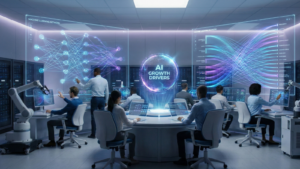
Key Drivers Behind AI’s Rapid Growth
AI development has not been an overnight process. Various highly influencing factors are promoting its development.
1. Explosion of Data
Every search, every click, every transaction, every interaction creates data.
AI systems flourish on:
- Big Data
- Real-time Data Streams
- Data related to user behavior
More data leads to better predictions, better automation, better performance.
2. More Computing Power
Current AI technology harnesses the following:
- Cloud Computing
- Specialized AI chips
- Faster Processors
That which would take several years to calculate a few decades ago would today take just seconds. This has greatly enhanced improvements in machine learning.
3. Automation Demand Across Industries
Businesses want:
- Speedier decisions
- Reduced costs
- Fewer errors
- Scalable Systems
For all these requirements, AI performs perfectly, explaining why its effects are witnessed today in finance, health, marketing, manufacturing industries, and even education.
4. Continuous Learning Systems
Unlike conventional software programs, an AI system becomes better with time.
With feedback loops and retraining, artificial intelligence techniques:
- Adapt to new patterns
- Enhance accuracy
- Cut inefficiencies
This self-improvement process makes AI powerful and purposeful, but not self-conscious.
Impact of AI on Jobs, Creativity, and Productivity
Jobs: Changing-Not Ending
AI is changing jobs, not eliminating humanity’s role.
Tasks that are most affected:
- Repetitive Work
- Data-intensive analysis
- Rule-based decision-making
Tasks still led by humans:
- Strategic thinking
- Leadership
- Emotional intelligence
- Ethics-based decision-making
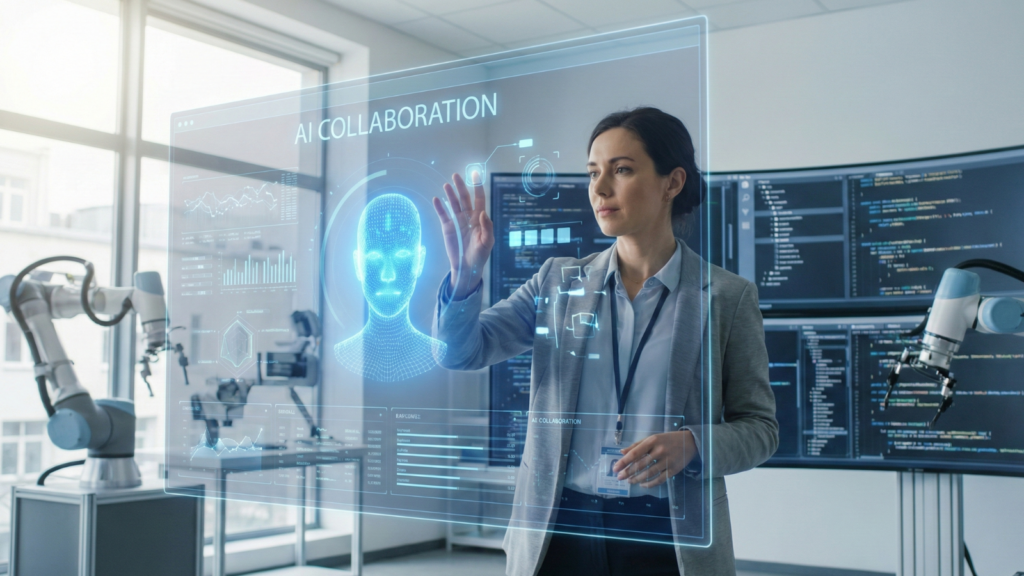
The future of work is not human vs. AI; it is human + AI.
Creativity: Human Creativity vs AI
It has the ability to create artwork, music, text, and designs. However, it is devoid of intention and emotion.
AI creativity is:
- Pattern-based
- Data-trained
- Imitative
Human creativity is:
- Emotional
- Purpose-driven
- Context-aware
This emphasizes that human creativity versus AI will now be a team effort, rather than a competition. The role of AI will be to assist with creation, with human input giving that creation
Productivity: Where AI Truly Shines
It increases productivity in the following ways:
Automating Repetitive Tasks
- Eliminating errors
- Increasing speed of processes
- Improving Decision Support
This allows humans to focus on higher-level thinking and not concentrate on such detail.
How AI Is Already Part of Daily Life
You don’t have to work in the tech field to see the impact of AI.
Common symptoms include:
- Smart assistants for mobile phones
- Recommendations on application software
- Tools for writing and design using AI
- Technology-driven customer services
- Intelligent navigation and traffic forecasting
These functions passively increase efficiency without substituting human control.
Why Extreme Opinions About AI Fail
Some people think that the replacement of all human beings by AI might happen. Some others feel that the potential of AI has been exaggerated.
Both approaches are incorrect.
Why ‘AI Will Replace Humans’ Is Wrong
- It lacks the capacity to comprehend emotions
- It does not possess an ethical guide
- The Algorithm cannot set goals on its own
- AI relies on human-created systems
Why “AI Is Just a Tool” Is Also Incomplete
- AI learns and adapts
- AI reshapes decision-making on a vast scale
- AI transforms industries quickly
The answer obviously is balance: AI has power, but it is toothless without humans.
Risks of Ignoring AI Evolution
If AI is simply ignored, it won’t prevent its progress. It is a disadvantage to ignore it
Possible risks include:
- Job displacement without preparation
- Lack Of Skill
- Lack of decision making
- Less competitiveness
Early adaptors will see the greatest benefits.
Who Will Lead the Future?
Who Will Lead the Future?
Thus, who wins in the debate between AI Vs human intelligence?
The answer is simple but powerful:
Humans… with the help of AI, where the force multiplier.
AI offers speed, scalability, and efficiency. Humans can supply the meanings and directions.
No future belongs to the machines or is set by human limitations. It is determined by just how smart humans use machines.
Conclusion: A Human-First, AI-Assisted Future
In 2026, Artificial Intelligence is among the most innovative technologies developed. Yet, it doesn’t replace human intelligence; instead, it makes us rethink it.
The future belongs to:
- Curious minds
- Adaptive thinkers
- Ethical leaders
- Creative problem solvers
The AI will continue to develop. Human intelligence has to develop alongside it—not in fear, but together.
It is where the balance lies, and it is where the true progress