Future of EdTech: Trends That Will Last Beyond 2030
By Naman | Future of EdTech | January 27, 2026
In the stock market, there is a thing called the “Lindy Effect.” This means that the longer something has been around, the longer it will probably last in the future. Books have been around longer than tweets. Therefore, books will probably last longer than tweets.
When I look at the Education Technology (EdTech) market in 2026, I use the same filter.
We also had a “pump and dump” stage back in 2020. Everyone was buying Zoom stocks and tablet computers, thinking that was the future. It wasn’t. That was just digitization.
Now, we are in the “Blue Chip” stage of new trends, which are fundamentally rewriting the operating system of human learning. These are not gadgets that will be obsolete by next semester. These are the infrastructure plays that will define the next decade.
As a student who is investing both my money and my time in my future, I need to know what skills and tools will still be relevant when I am 30 years old. Here is my analysis of the EdTech trends that have “compound interest” potential beyond 2030.
1. AI Agents: From “Tutors” to “Lifelong Managers”
In 2023, we were blown away by ChatGPT’s ability to write an essay. In 2026, that’s just the price of admission.
The game-changer is from Generative AI to Agentic AI.
- Generative AI responds to your question.
- Agentic AI realizes you are struggling with Calculus, sets up a 15-minute review session on your calendar, creates a personalized quiz based on your previous errors, and even sends an email to your professor to clarify a particular topic.
Why it will succeed beyond 2030: The “one-size-fits-all” lecture format is over. By 2030, every student will have a “Digital Twin”—an AI companion that has shadowed you from kindergarten through college. It will know exactly how you learn (e.g., “Naman learns best with visual metaphors, not text blocks”) and will instantly convert every textbook into that format.

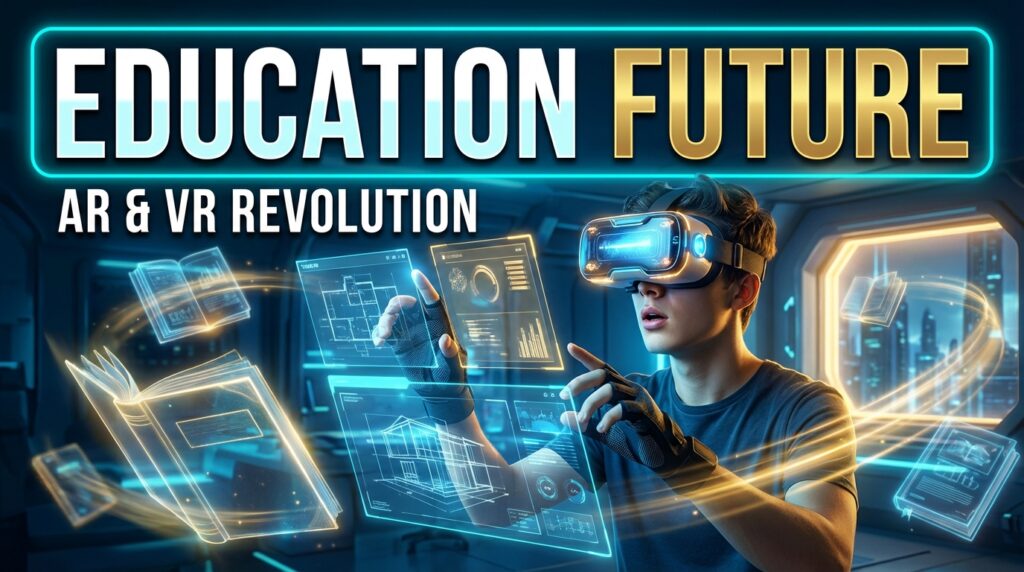
2. Spatial Computing: The End of “2D” Learning
I personally experienced a VR headset to explore a 3D model of a Black Hole for my Astrophysics elective. It took 10 minutes to grasp ideas that would have taken 10 hours of reading.
As of 2026, technology such as the Apple Vision Pro and Meta Quest has shifted from “gaming toys” to “spatial computers.”
The Trend: We are shifting from Abstract Learning (reading about a chemical reaction) to Experiential Learning (combining the chemicals in a virtual lab with absolutely no risk).
Why it will stick beyond 2030: The human brain is designed to recall locations and experiences, not words. Spatial computing exploits our biology to boost retention rates by 400%. By 2030, medical students will not lay hands on a cadaver until they have done 100 virtual surgeries flawlessly.
3. The “Wallet” for Your Degree (Blockchain Credentials)
I have certificates from Coursera, a degree from my university, and badges from coding boot camps. Currently, they are disorganized PDF files that not a single employer trusts 100%.
The answer is Sovereign Identity on the blockchain.
The Concept: You have a digital wallet. When you complete a course, the university puts a “Verifiable Credential” (token) into your wallet.
The Benefit: You own your degree. If the university goes out of business, your degree still exists. Employers can check your skills in 1 click without bothering the registrar’s office.
Why it will endure past 2030: The job market is going global and skills-based. We need a trustless, instant way to prove “Person A actually knows Skill B.” The paper resume is dead; the cryptographically-verified portfolio is the future.

4. Soft Skills Quantified (EQ is the new IQ)
For years, we assessed IQ because it was simple. We didn’t assess EQ (Emotional Intelligence) because it was “fluffy.”
In 2026, AI is now able to assess soft skills.
The Technology: In a simulated interview, AI evaluates your micro-expression, your tone variation, and your empathy. It provides you with feedback: “Your Empathy Score is 72/100. Try listening 10% more before speaking.”
Why it will stick after 2030: As AI takes over the technical coding and writing, human empathy is the most valuable thing. By 2030, your “EQ Score” may be more valuable than your GPA in securing a leadership position.
Impact on Students, Teachers, and Institutions
However, this paradigm shift is not without its pains. It results in winners and losers.
For Students (The Winners): We have freedom. We can watch the video at 2x speed or 0.5x speed. We are not forced to go at the pace of the slowest student in the class.
For Teachers (The Pivot): The “Lecturer” role is no longer needed. Why lecture when an AI can explain the topic better? Teachers will now be “Mentors” and “Facilitators.” Their role is to motivate, not educate.
For Universities (The Crisis): If I can get a better education from a $50/month AI subscription than from a $50,000/year university education, why pay tuition? Universities need to adapt to becoming “Communities” and not just “Content Providers.”

Conclusion: Invest in Adaptability
“The Future of EdTech” has nothing to do with the technology itself. It has to do with the efficiency of knowledge transfer.
As a student in the year 2026, I am optimistic about these trends because they value my time. They value me as an individual, not just a statistic.
My advice would be to not be so attached to the traditional ways of learning just because they are comfortable. The market does not reward stubbornness; it rewards flexibility. Begin using AI agents. Begin constructing your digital portfolio.
The train has left the station. Make sure you are on it.