Android vs iOS: Which Is Better in 2026?
By Naman | Android vs iOS | January 22, 2026
It was a battle of “Green Bubbles vs. Blue Bubbles.” It was a battle of “Customization vs. Simplicity.”
We are no longer in 2026, though, and the Android versus iOS struggle has drastically changed. In our current scenario, we are not simply deciding on a smartphone display; rather, we are selecting an AI Co-Pilot.
First, if you’re reading this on an iPhone 17 or a Pixel 11, you understand why the hardware is not really innovating any longer. Cameras: they’re all GREAT. Displays: they’re all 120+Hz OLED panels.
Where the magic happens: “The Intelligence Layer,” which is the invisible software “brain” in charge of running your life, safeguarding your information, and guessing what you’re going to do next.
In short, what is the state of the “Walled Garden” versus “Open World” during the reign of Agentic AI and the dominance of foldable technology? Has the “Sanctuary” turned into a “_prison” for Apple, while the “playground” turned into a “nightmare” for Android?
“So let’s put this question to rest for the user of 2026
Android vs iOS: The AI Philosophy Divide
“The largest difference in the 2026 model comes not in the icon pack but in the brain of the machine.”
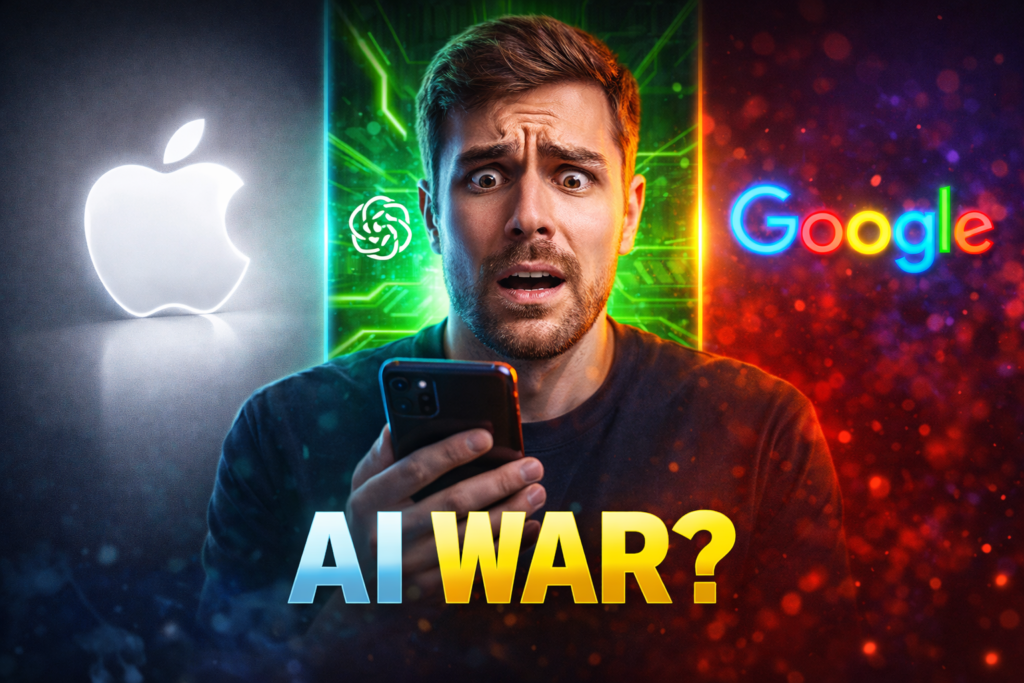
Google’s Approach: “The All-Knowing Agent” For the Android 16 operating system (and the forthcoming version 17), Google has incorporated the Gemini into the operating system’s kernel.
The Pro: “Your Android phone exhibits Contextual Omniscience.” It understands that you’ve already purchased concert tickets in your Gmail account, that you are running late due to traffic in your Maps application, and that your phone automatically sends a text message to your friend stating that you are running late – all without your having to unlock the phone.
The Con: “To be this smart, Google needs all your data,” which means that the user must pay the price of privacy for the convenience of using the search engine
Apple’s Approach: “The Private Vault”
Apple Intelligence, in its more mature stage in iOS 19, pursues a different path.
The Pro: On-Device Processing. Most of what you do with AI is done on the Neural Engine that’s in the device. To be able to perform even more processing, it relies on “Private Cloud Compute,” so your information isn’t accessible to Apple.
The Con: Siri is safer but “dumber.” It will rarely attempt to connect the dots in the apps to enter information automatically if there’s a privacy risk, so it will feel a bit more like work than Android’s “magic.”
Features & Customization: The Gap Has Closed
Do you remember the days of iPhone ownership when you could not put an icon where you wanted it? Those are ancient days.
Android (The Shapeshifter)
Android continues to be the master of hardware variations.
Form Factors: The market for foldable phones is matured in 2026. Samsung Fold Z7 and Pixel Fold 3 support tri-fold designs which allow you to convert your phone into a genuine tablet measuring 10-inch. Only an Android phone can be a transformer if you want that!
UI Freedom: Material You has grown in capabilities. Now, the OS themes of all kinds, along with sound effects and background images, can all be created with the help of AI based on the user’s mood.
iOS (The Refined monolith)
Customization has long been an Achilles’ heel for iOS, but in this
Interactive Widgets: These are now mini-apps. You can control your smart home or track stocks without opening the full app.
The ‘iPhone Flip’ Element: Although rumors of a foldable Apple device continue to circulate, the operating system is primarily optimized for the ‘Slab.’ It is refined, predictable, and extraordinarily fluid. The animations present in iOS 19 feel like fluid physics.
Security & Privacy Comparison: The “Stealth” Update
Security is a #1 concern for users in 2026, and with good reason. With the rise in artificial intelligence-based deepfake and voice-cloned technology, your phone becomes your digital identity.
iOS: The ‘Fort Knox’ Reputation
Apple brought out “Stealth Mode” in iOS 19.
What it does: It’s possible to hide bank or dating apps. They will not be visible in search, settings, or notification alerts until you unlock using FaceID.
Tracking: “App Tracking Transparency” of Apple is now militant. It is hard for applications to make a profile of you, which is good for you, but very annoying if you are enjoying targeted ads.
Android: The “Fraud Hunter”
Google fought back with Real-Time Fraud Detection.
-
What it does: Android uses on-device AI to listen for “scam patterns” when you receive a phone call. If a caller asks for your password or uses artifacts of voice cloning, for example, the phone will flash red mid-call as a warning.
-
Sandbox Evolution: Android’s “Privacy Sandbox” is finally rid of third-party cookies but still remains an ad company’s OS at heart.
Winner: iOS for pure privacy. Android for active threat protection.
App Ecosystem & Updates: The 7-Year Standard
“Android phones don’t get updates” – the old chestnut is deceased.
Longevity: Google and Samsung currently rival Apple by providing 7 years of OS
Updates to match their standard. So, a Pixel bought in 2026 will be brand-new in 2033.
App Store vs. Play Store:
iOS: Gets to experience the “creative” apps first. If you’re a designer, musician, or video editor, the ecosystem surrounding the iPad and iPhone is better with unique apps such as Procreate Dreams available on their devices first.
Android: The winner when it comes to “sideloading.” Alternative application retailers are ubiquitous in the year 2026. You can also obtain emulators or AI application tools prohibited by Apple.
Conclusion: The “Best” is Personal
In 2026, bad phone does not exist anymore. The best Android phone and the best iPhone are works of engineering miracles.
If you are a Tech Optimist who thinks AI must manage your life to save time, Android is the cockpit for you. If you are a Digital Humanist who wants technology to just sit in the background as a safe catalyst for your creativity, iOS will be the haven for you.
“The war is over. Both sides won. Now, you have to make a choice: which uniform to wear?”