How Cloud Computing Works: Types & Benefits (2026 Edition)
By Naman | Cloud Computing | January 22, 2026
Take a look out at the sky. You see some clouds, correct? Now look at your smartphone. You see. the other cloud.
By the year 2026, “The Cloud” is no longer a catch phrase used by marketing people for a marketing sound bite. It is the invisible power source for our entire civilization, just as electric power or running water is.
When you ask your AI to book a flight, guess what isn’t crunching the numbers, the math in the cloud. When you stream 8K Digital in Virtual Reality without a hiccup, the cloud is working its magic. When you’re in a self-driving car and the driverless vehicle swerves to avoid a pothole, that’s the cloud updating the database in a vehicle three minutes ago.
However, the cloud, which sustains the modern world, is still a kind of magical “hard drive in the sky” in most people’s views today.
Well, it is much more than that. Let us demystify the engine room of the internet and tell you how it really works, why, and how it grew into the AI monster we all know and love nowadays.
What Is Cloud Computing?
Cloud Computing can be defined in the simplest way as the provision of computing resources such as servers, storage, databases, networking, software, and intelligence via the Internet, commonly referred to as “the cloud”).
Let me give you an analogy. Think of it like a pizza shop
Traditional IT (On-Premises) : You buy a pizza oven, pizza dough, cheese, and toppings. Then you cook the pizza yourself. If you require two pizzas, then you may require a second pizza oven.
Cloud Computing: You simply order the pizza. You do not care which oven they used to cook it or who kneaded the dough. You pay for the slices that you eat.
In 2026, the Cloud concept continues to evolve in terms of its definition. The Cloud not only pertains to storage; it pertains to intelligence. The Cloud can be defined as a huge common supercomputer that enables a low-cost smart watch to possess the intellect of a genius.
How Cloud Computing Works
The magic behind the cloud occurs because of something called Virtualization.
In a conventional data center, one server supported one operating system. It is an inefficient way of doing business. For example, if a server is utilizing only 10% of its resources, then 90% is wasted.
Cloud service providers (like Amazon Web Services, Google Cloud, or Microsoft Azure) employ software on their servers to partition a physical server into several “Virtual Machines.” To you, the user, it would appear as if you have your own private machine in front of you, while in reality you all share one enormous machine with thousands of other people, with your own part carefully isolated.
The Front End vs. The Back End
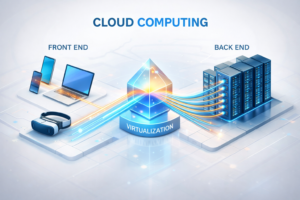
- The Front End: This is you. Your computer, tablet, or virtual reality goggles. You make a request (e-teR (for example, “Open Netflix”).
- The Back End: THIS is who THEY are. Huge warehouses stuffed with flashing servers, cooling systems, and security interns. They have a “Traffic Controller” server that distributes the traffic of requests to make YOUR movie play instantly.
Types of Cloud Computing
Not all clouds are created equal. Depending on your needs—privacy, speed, or cost—you will use a different type.
1. Public Cloud (The “Bus”)
-
What it is: It belongs to a third-party service provider such as Google, Microsoft, and Amazon. It is shared by the general public.
-
Best for: Emails, Google Docs, Netflix, and general AI tasks.
-
2026 Context: It is the least expensive and most efficient alternative.
2. Private Cloud (The “Personal Car”)
-
What it is: Cloud computing for the exclusive use of a business/organization. It can either be hosted in the business’s data center/location or outsourced to a third party service provider
-
Best for: Banks, Governments, or Hospitals which have data that they do not want to mix up with other data because of certain regulations.
3. Hybrid Cloud (The “Hybrid Vehicle”)
-
What it is: This is a mixture of public and private clouds that are interconnected using technology which enables sharing of data and applications across the cloud systems.
-
Best for: A company that stores its sensitive customer data in a Private Cloud but uses the Public Cloud for running its customer website.
4. Edge Computing (The 2026 Standard)
-
What it is: This is “the big change.” Now instead of having all the data go back to a central location to be processed, it happens “at the edge,” or where it’s created (your self-driving car or smart manufacturing plant).
-
Why it matters: Speed. When a car is braking, it certainly cannot wait 100 milliseconds for the response of a server in Virginia.
Conclusion: The Invisible Engine
The journey of cloud computing from a “new technology” to a “fundamental utility” is complete.
“Do we need the cloud?” will be like asking “Do we need electricity?” in 2026. It will be the invisible engine of our world of AI, safeguarding our memories and connecting our world.
As a user, the greatest benefit we have from the cloud is that we do not need to worry or even think about it. It just happens unnoticed in the background, allowing us to create, discover, or connect. That is the power of the cloud.
The next time your phone instantly recognizes your face or the movie continues seamlessly from the last time you watched it, spare a thought for the huge invisible system that makes this work.