How Much Daily Water Intake is Good? Myths vs Facts
By Naman | Daily Water Intake | January 22, 2026
This common recommendation we have all been given. It has been ingrained within us from a young age through grade school announcements from PE teachers and posted on every health-related blog on the internet: “You need to drink eight glasses of water every day.”
It sounds simple. It sounds sensible. But here is the problem: it is mostly nonsense.
First, in 2026, we are beyond generic healthcare recommendations. We can optimize diets to our specifications, workout according to our genetic material, and monitor our stress levels on our own personal wristwatches. But in terms of how much water we drink every day, most of us are still operating on a guideline from the 1940s that couldn’t be supported by science anyway.
“I was that dude walking around the office with the gallon jug of water, challenging myself to drink enough until I was sloshing, thinking I was ‘optimal’ and ‘maximizing’ my health—what I was really doing was spending the better half of my day in the bathroom.”
The reality when it comes to hydration is a whole lot more complex—and frankly, a whole lot less stressful—than the “8×8 Rule.” Well, let’s cut through the hype, take a look at the science, and see just how much water YOU should be drinking.
Why Hydration Is More Than Just Quenching Thirst
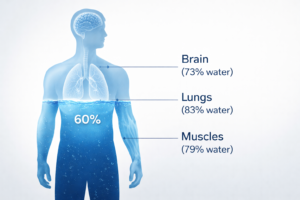
Before we discuss the numbers, I think we have to discuss the “why.” You probably know the importance of water. What is the function of water, though? You are about 60% water. Each individual cell in your body is basically a water balloon.
When your fluid levels are appropriate, it’s like having a well-tuned machine. Water is the carrier molecule for continued nourishment entering cells, as well as removing waste from the kidneys. It helps to regulate the temperature of the body by sweating off excess heat or exhaling it as an evaporation of the air we breathe out. It acts as a lubricant for the joints (if you have a clicking kneecap when you squat down, it might have something to do with your hydration).
In terms of productivity in 2026, hydration is an intellectual aid. Scientifically, researcher-cited studies have proven that mild dehydration from losing 1-2% bodily water content already leads to impaired cognitive function. This refers to lacking concentration, havingIssues with headaches, or experiencing a significant crash when it comes to mood. Maybe you’re not really needing a caffeine boost; maybe what you need is a bottle of water to perk you back up.
Daily Water Intake Myths: What We Got Wrong
Let’s kill the bad advice that just won’t die.
Myth 1: The “8 Glasses a Day” Rule
originated from the misinterpretation of a recommendation dating back to 1945. It recommended that the human body needs to take approximately 2.5 liters of water a day, but-and this was what everyone ignores-it was added that most of it comes from food; you should not drink 8 glasses of complete liquid water over and above your diet.
Myth 2: Coffee and Tea Dehydrate You
People have been saying for years that caffeine is a diuretic, so coffee cups don’t count. But this is simply not true. Caffeine slightly increases urine production, but the water in your coffee cup far exceeds this effect. So, if you’re a coffee drinker, your body will compensate for this, and yes, coffee cups do count toward your daily water intake.
Myth 3: Thirst Is a Sign You Are Already Dehydrated
This This is a half-truth. In older persons, there may be a delay between the initiation of thirst and its perception. In a young, healthily functioning adult, however, your thirst mechanism is absolutely precise. Thirst or not, drink or do not drink—it’s all remarkably simple. Our evolution didn’t account for us needing a calculator to calculate when to have a glass of water.
Ideal Water Amount: What is Your Number?
Therefore, if 8 glasses is not the law, then what is?
The National Academies of Sciences, Engineering, and Medicine recommend these total amounts of water intake (from foods and drinks combined):
- Men: 3.7 liters (15.5 cups) daily.
- Women: 2.7 litres (11.5 cups) per day.
Wait, don’t be alarmed. You don’t ever have to drink 3.7 liters of fluid from a bottle. About 20% of your fluid intake is obtained from the foods that you consume. It includes cucumber, watermelons, soup, even meat like steak that has fluid in it. So men are left to drink 3 liters, which is about 100 ounces.
Factors That Change Your Number
The “magic number” is variable and fluctuates daily according to the following factors:
Environment: In a tropical, moist environment or in higher altitudes, your basic needs increase.
Diet: A high sodium or a high protein diet requires a higher water intake to aid the kidneys to eliminate the wastes.
Real World Calculation: Take your weight in pounds and divide by 2. This is a good starting point on how many ounces you should be aiming for. If your weight is 180 lbs., shoot for 90 ounces. This increases if you exercise.
Signs of Dehydration (Besides Thirst)
Often times we find ourselves fixated on our jobs to the point that we ignore our bodies’ thirst signals. This is how you know when you need to replenish your fluids:
- “Pinch” Test: Pinch the skin on the back of your hand. If it snaps back immediately, then you’re okay. However, if it tents up for a second or two before flattening back out, then you are dehydrated (this is called skin turgor).
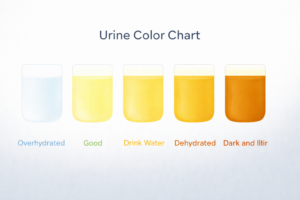
- Urine Color: This is the standard by which you can judge yourself. You want a light yellow, lemonade-like appearance. If you’ve been running around with apple juice-colored pee or amber-colored pee, you’re way behind. If you’re peeing clear, you might be overdoing it.
- Fatigue & Dizziness: Dizziness or lightheadedness associated with standing up quickly is a common symptom of low blood volume dehydration.
- Dry Mouth and Bad Breath: The saliva in the mouth contains properties that inhibit the growth of bacteria. Since you have less saliva when you have a dry mouth, the bacterial count escalates, thus giving you bad breath.
The Danger of Overhydration (Hyponatremia)
Yes, you can drink too much water. In the fitness industry, this phenomenon is on the rise and is sometimes more prevalent than dehydration.
This condition is referred to as hyponatremia. This can result from the excess water consumed that ultimately leads to a dilution of sodium ions in the bloodstream. Sodium has functions as an electrolyte that helps maintain the water balance around cell bodies. After being diluted to a certain extent, cells begin to swell.
In mild cases, symptoms may include headaches and vomiting. Severe cases (notably common in marathon runners who consume fluids at every station even if not thirsty) can be fatal and result in seizures or coma.
The Rule: “You never want to force feed your body water.” If your stomach is sloshing, stop drinking! If your pee is crystal all day, tone it back! Moderation is key!
Best Time to Drink Water for Maximum Benefit
The key to optimizing your body’s use of water may be timing.
Right After Waking Up: You just abstained from water for the last 8 hours. Your blood is now thick and viscous. A 16oz drink (large glass) jumpstarts the metabolic process.
30 minutes before a meal: This aids in the preparation of the stomach for digestion. Curious, the consumption of liquids during meal times is perfectly acceptable, but eating a lot of liquids during the meal can result in bloating due to the concentration of certain enzymes in the body being reduced by the large fluid intake.
PRE-and DURING Exercise: Do Not Wait Until You Feel Out of Breath. PRE-load water 20 minutes before Exercise.
The ‘Afternoon Slump Window’: Instead of having a second coffee at 3 PM, the ‘Afternoon Slump Window’ recommends having a glass of water. It stimulates the nervous system.
Conclusion: Listen to Your Body, Not the Hype
At the end of day one in this diet series or any diet series for that matter, your body is far smarter than any application or blog post on Earth.
Try not to obsess about reaching some magic number such as “8 glasses.” Just try to establish a baseline (half your body weight in ounces), check the color of your urine periodically, and keep a water bottle with you so it is available when you need it.
Hydration should BE fuel FOR your life, not a full-time job. So: Drink up. Stay sharp. Keep it simple.
Frequently Asked Questions (FAQ)
Q: Does sparkling water count toward daily water intake?
A: Absolutely. Sparkling water is just water infused with carbon dioxide. It hydrates you just as well as still water. Just watch the flavored versions as they can add sugars or high acidities which will be bad for your tooth enamel if drank through the day.
Q: Does water actually help with weight loss?
A: Indirectly. Drinking water before a meal can help you feel fuller, leading to reduced calorie intake. Also, replacing high-calorie sugary drinks-soda, juice-with water is one of the fastest ways to cut daily calories. Other studies say cold water slightly increases calorie burn as the body heats it up, though the effect is at a minimal degree.
Q: Is alkaline water better for you?
A: The science is thin on this one. The alkaline water-pH 8 or 9-is marketed as a way to neutralize body acidity, but your body naturally maintains a very strict pH balance on its own. Unless you have a certain medical condition, such as acid reflux-where it might help neutralize stomach pepsin-regular tap or filtered water is perfectly sufficient and much cheaper.
NOTE: This is for educational purposes only. Not medical advice. Consult a doctor for health concerns.