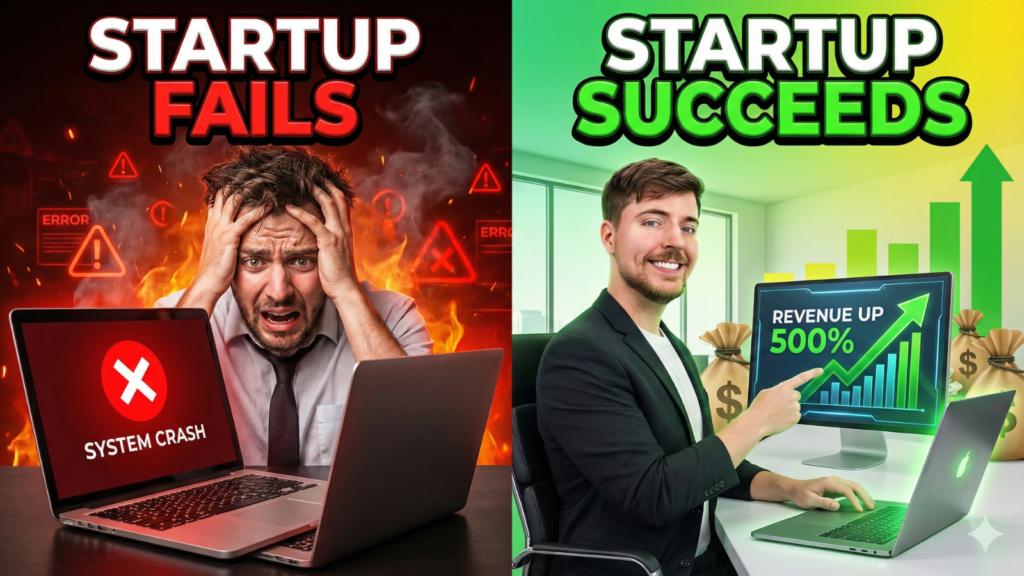
Introduction: The AI vs Human Debate in Startups
By the year 2026, the dialogue about technology in startups has changed. Entrepreneurs no longer wonder whether AI will replace humans; they wonder whether humans and AI can work together effectively. Startups remain at risk in the first year as they attempt to balance innovation and growth.
AI Tools , automated platforms, and cloud solutions are the essential requirements for new business setups. In fact, these solutions have enhanced productivity and reduced the need for menial tasks, and it was impossible to gain such insights even a few years ago. Nevertheless, the human factor is essential, and strategy, creativity, and decision-making should not be outsourced.
Learning the most common technology errors early on can save a start-up time, money, and even energy, all while allowing them to build a scalable platform.
Common Tech Mistakes Startups Make in Their First Year
1. Over-Engineering the Product
- What happens is that the founders of a startup aim to incorporate as many features as possible within the application.
- Why it’s a mistake?: It holds back the launch of the market and incurs additional development expenses.
- Solution: Emphasis on MVP to validate concepts more quickly. Leverage the power of AI analytics to focus on the most important product elements based on customer requirements.
Human Oversight: While AI has recommendations on what features work well, only human perspectives aggregate what actually helps businesses.
2. Ignoring Scalable Architecture
- What is observed: Startups develop solutions that are of a temporary nature and are designed with scalability
- Why it’s wrong: The system will break as the number of people using it goes up.
- Solution: Cloud native infrastructure and modularity enabling scaling without having to restart from scratch. AI monitoring allows for predictions and resource optimization.
3. Poor Cybersecurity Planning
- What happens: Security often becomes an afterthought in the mad rush to go live.
- Why it’s wrong: Data breaches, hacking incidents, and failures of compliance can be ruinous for reputation and legal standing.
- Solution: Impose massive security from the very beginning. Utilize threat detection and vulnerability assessment powered by AI to prevent breaches.
4. Underestimation of Data Management Requirements
- What happens: Startups are collecting data, but failing to organize it well.
- Why it is a mistake: Poor data management creates blind spots and slows down decision-making.
- Solution: Utilize AI for cleaning, categorization, and analysis of data. Also, apply a data strategy in correlation with business KPIs.
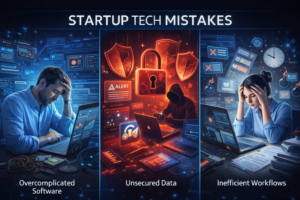
5. Not Leveraging AI and Automation Early
- What happens: It’s where startups just try to scale manually, getting more people instead of optimizing with technology.
- Why it’s a mistake: It wastes time, boosts costs, and reduces the pace of learning cycles.
- Integrating AI tools into customer support, content creation, workflow automation, and market research will make a big difference.
Human Advantage: Humans define priorities, tone, and customer empathy while AI handles repetitive tasks efficiently.
6. Selection of Wrong Tech Stack
- What happens: Startups tend to select tools based on trends or founder preferences, not on actual needs.
- Why it is a mistake: Mismatched tools create inefficiencies and technical debt.
- Solution: The tools must be reviewed for scalability, integration, cost, and team acquaintance. Suggested AI-driven platforms can help pick up the right stack.
7. Lack of Concern for Future Skills and Training
- What happens: Teams lack the knowledge of how to leverage advanced technology.
- Why it’s a mistake: In addition, underutilization of AI tools and automation decreases the return on investment in technology.
- Solution: Invest in employee training on AI literacy, prompt engineering, and workflow optimization.
8. Dependency on Third-Party Tools
- What happens: Startups keep their dependence solely on external platforms without having any plans.
- Why it’s a mistake: There may be outages, price hikes, and API updates.
- Solution: Integrate hybrid workflow solutions by leveraging third-party software as well as internal knowledge where necessary. AI can help one track third-party dependencies.
Tips to Avoid Tech Mistakes
- Validate before build: Leverage data insights and analytics from AI for product and feature development guidance.
- Plan for Scale: Cloud architecture, modularity, and AI monitoring will ensure a failure-free future.
- Secure from day one: Cybersecurity solutions and threat intelligence are mandatory, not optional.
- Automate intelligently: Use AI to automate repetitive tasks, so humans can focus on strategy and creativity.
- Train your team: “AI literacy and technology skills are a competitive advantage that lasts.”
- Review tech stack periodically: Make sure your tech stack keeps up with business requirements.
Conclusion: A Tech Lover’s Perspective
Technology is a double-edged sword for startups in 2026-accelerating growth or creating bottlenecks based on how it is used. AI tools, cloud platforms, and automation are indispensable; however, human intelligence and judgment cannot be replaced.
Indeed, the most successful startups are those that marry technology with human insight: deploying AI for speed, scale, and analysis, while humans work on strategy, ethics, and creativity.
Grasping at common tech mistakes and understanding AI integration could be how a startup can lay the foundation for the future, minimize risks while maximizing innovation and impact. In 2026, the smartest startups won’t choose between humans and technology; they harness both for exponential growth.