

Why the EV Sector Is Growing Faster Than Ever: Trends You Must Know
The pace of the EV Sector Growth is accelerating to an unprecedented level. This industry, which only a few years ago was considered to be a niche passion for EV enthusiasts, has become a worldwide phenomenon that is transforming the means, manner, and even patterns of transport, energy, and even urban planning. Furthermore, as someone who is passionate about and keeps abreast of developments in EV technology, I can see from firsthand experience how technological developments, government policies, and public acceptance are contributing to the swift EV Sector Growth.
Understanding the EV Sector Growth for Beginners
The EV sector, in simple terms, represents manufacturing, adoption, and infrastructure involving electric vehicles. This would involve not only cars but also two-wheelers, buses, trucks, and all allied technologies on battery innovation, charging networks, and software-driven vehicle management.
For the newbies, the simplest way to envision it would be: replacing traditional fossil-fuel vehicles with their electric-powered counterparts. This switch affects everything from the cost of commuting to urban air quality. By 2026, the EV sector is no longer a future concept; it’s a present-day reality transforming industries.
Key Drivers Behind EV Sector Growth
1. Battery Innovation
Batteries are the lifeblood of EVs. Advances in lithium-ion, solid-state, and novel battery technologies have escalated the energy density and charging speeds, and lowered costs. The result is that EVs are no longer a means to an end for commutes, but also serve for long range journeys. EVs are likely to become even more affordable and efficient with improvements in battery technologies.
2. Public Policies & Incentives
The world’s administrations are promoting the use of EV’s quite aggressively. Tax benefits, subsidies, and emission-reduction initiatives have been some of the most encouraging motives for consumers as well as the automotive industry to move ahead from traditional internal combustion-powered vehicles to electric vehicles. Net-zero initiatives of the countries targeting the year 2030 have been fueling this development.
3. Cost Reduction by Scale Advantage
While mass production increases, prices for cars as well as battery costs are gradually dropping. Economies of scale, together with technology improvement, have helped electric cars get closer to gasoline cars in terms of costs and competitiveness. Decreased owner-operating costs, as a result of low fuel and maintenance costs, attract customers to purchase EVs on a larger scale.
4. Smart Mobility & Innovation
Electric vehicles are being amalgamated with intelligent transportation systems and connected vehicle technologies. Features such as AI-powered driving assistance, predictive maintenance, and fleet management are adding to the benefits of the users and are also making the transportation systems in the urban areas much more efficient and sustainable.
How EV Sector Growth Impacts Daily Life
The ramifications of EVs are well beyond the vehicles, because:
- Lower Noise Pollution: EVs are far quieter compared to conventional cars.
- Reduced Operating Costs: Electricity is cheaper than petroleum, and maintenance is also less.
- Improved Urban Planning: Cities are redesigning roads, parking spots, and charging points for EVs.
- Career Development: Opportunities in the areas of electric vehicle servicing, software, and charging technology.
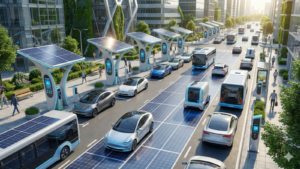
Signs That EV Adoption Is Accelerating
You can see the expansion of EVs occurring in the following ways:
- More electric vehicles in use: Expect to spot more electric sedans, sport utility vehicles, and scooters.
- The number of public and private charging points is increasing: There is a charger at every mall and office building.
- Government incentives : Tax refunds, subsidies, and benefits encourage consumers to buy EVs.
- Corporate adoption: Electric adoption in delivery fleets and ride-sharing services.
These are definite signs that the pace of growth in the EV industry is anything but slowing—it’s going mainstream.
Common Misconceptions About EV Sector Growth
Despite the progress, many myths linger:
- EVs are slow or lack power: Modern EVs provide immediate torque, fast acceleration, and excellent high-speed performance.
- Charging takes too long: The current fast charging technology allows charging 80% in less than 30 minutes.
- The cost of EVs is high, but thanks to the principle of mass production and competition, the prices of EVs have changed and are now comparable
Practical Tips for Users and Investors
- For Consumers, consider the factors of range, charging stations, batteries, and total cost of ownership when deciding which electric vehicle to buy.
- For Investors: Opportunities exist in batteries, charging infrastructure, and the electrification of the fleet. The last area is the expected source of the strongest growth.
- For Electronics Fans: Knowledge about car software connectivity, smart grids, and renewables will position you for success in this rapidly changing industry.
Risks of Ignoring EV Sector Growth
Missing out on EV Sector has consequences:
- Environmental penalties of the use of fossil fuels.
- Missed Opportunities within a Fast-Growing Market Sector
- Lack of competitiveness in new technology areas, ranging from battery technology to AI-based vehicle control systems.
The Future Outlook for the EV Sector Growth
The pace of growth in the EV industry will accelerate through the rest of the decade. Improved batteries, charging infrastructure, and the capability to interface with smart cities will mean EV domination of the passenger and commercial transport sectors. Those that adapt to change will realize the benefits of financial, environmental, and technological gain. Tech fanatics, it’s an exciting time where mobility, intelligence, and sustainability come together.