
Introduction: AI, Humans, and 5G vs 6G
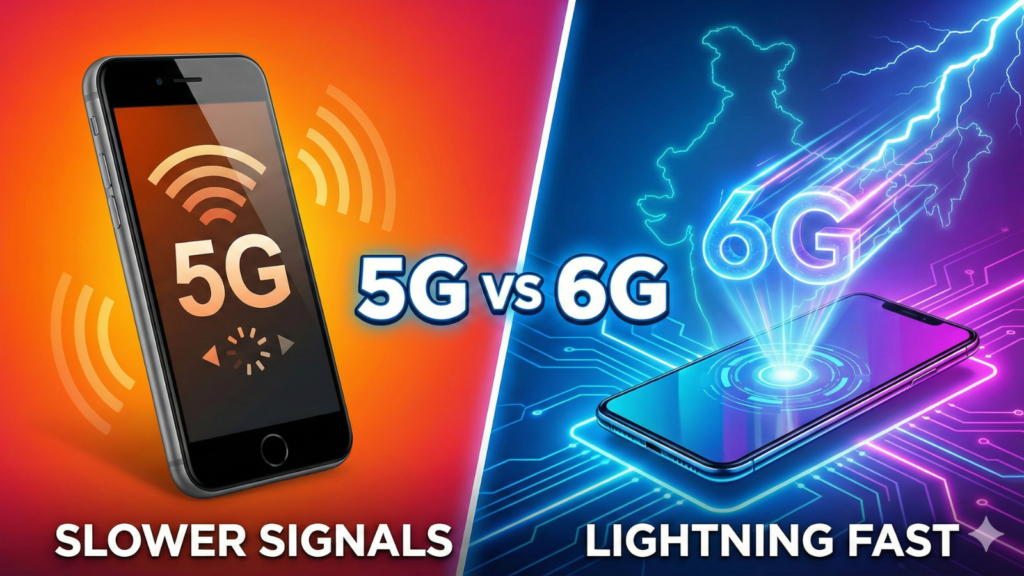
Looking ahead to 2026, the discourse on AI as well as human intelligence is in large part connected to development in connectivity technologies. This is because 5G connectivity, along with the development of 6G ( 5G vs 6G ), is not only fast but also enables automation and data processing through artificial intelligence.
Although these capabilities of humans lie in creativity, context, and decision, AI excels in speed, patterns, and large datasets. Current networks further magnify these capabilities of AI, enabling intelligent cities, autonomous vehicles, and the Internet of Things.
It is important to know the distinctions between 5G and 6G to make optimal use of both in the business world and technological environments.
Key Differences Between 5G and 6G
| Feature | 5G | 6G |
|---|---|---|
| Peak Data Speed | Up to 10 Gbps | Expected 1 Tbps |
| Latency | 1-10 ms | <1 ms (sub-millisecond) |
| Frequency Range | 3-100 GHz | 100 GHz – 1 THz (terahertz spectrum) |
| AI Integration | Limited, mostly network management | Native AI-driven network optimization |
| Applications | Smart cities, AR/VR, IoT | Holographic communication, autonomous transport, advanced AI edge computing |
| Network Architecture | Standalone and Non-Standalone 5G | Fully decentralized, ultra-low latency, AI-managed slices |
1. Speed and Latency
- 5G: Offers a max data speed of 10 Gbps with a latency of 1-10 ms. This supports smoother video streaming, AR, and quick data transfer in IoT.
- 6G: It should attain speeds of 1Tbps along with less than one millisecond latency, enabling holographic phone calls, self-driving robots, and real-time AI decisions.
Human Advantage: The high speed of the networks enables humans to process their insights quickly and devote time to creativity.
2. AI and Automation Integration
- 5G: Primarily employs AI technology to manage network traffic and perform predictive maintenance.
- 6G: Will incorporate AI directly into the core, which will optimize bandwidth and make predictions based on user behavior.
Impact: Real-time AI and machine intelligence services for healthcare, intelligent manufacturing, and self-driving cars will become common.
3. Frequency Spectrum
- 5G: Principally in sub-6 GHz and millimeter wave band (up to 100 GHz).
- 6G: Would utilize the terahertz bands (between 100 GHz and 1 THz), providing better bandwidth and even lower latencies than 5G networks. It would require new equipment for its reception and transmission.
4. Applications
5G Applications:
- Smart cities and connected devices
- AR/VR and Immersive Media
- IoT and autonomous drones
6G Applications:
- Holo-graphic communication and augmented reality
- AI-powered real-time decision-making for industries
- Ultra-reliable, low-latency autonomous transport systems
- AI-enhanced global surveillance and climate monitoring
5. Network Architecture
- 5G: SA and NSA dual-mode support for coexistence of LTE and 5G.
- 6G: That shall be fully decentralized with the AI-based management and with intelligent network slicing, adaptable automatically to the user’s demands.
Human Advantage: AI-driven networks minimize the need for human intervention in mundane tasks of the network. Humans can then focus on higher levels of governance, policies, and creative applications.
Launch Timeline for 6G in India
India has kicked off its research work for 6G technology.
- 2022-2023: Formation of initial research partnerships between IITs, the government, and telecom
- 2024-2025: Terahertz experiments and integration testing of AI
- 2026:Pilot trials in major cities with limited coverage.
- 2028-2030: Anticipated commercial launch in the Indian market with a gradual startup in urban and semi-urban areas.
Opportunities for Startups and Professionals:
- Artificial intelligence applications on 6G edge computing
- “Next-generation” IoT devices and smart city solutions.
- Telemedicine and holographic educational platforms
Tips for Leveraging 5G Vs 6G Effectively
- Use AI-ready infrastructure: Develop gadgets and applications that can take advantage of ultra-low latency networks.
- Emphasis on Edge Computing : Reduce latency by processing the data closer to the source.
- Terahertz Technology Preparation: Conduct research and prepare for hardware that can support transmission within a higher frequency range.
- Create AI-first applications: The networks will be optimizing in real time, and your application better be able to utilize this optimization.
- Upskill the workforce: Educate engineers and developers on AI, IoT, & 6G Protocol
Conclusion: A Tech Lover’s Perspective
It is not just an upgrade from 5G to 6G; it is a new world of AI-enabled connective technology. It will have submillisecond latency and operate at terahertz frequencies. It will allow mankind to do things that were just sci-fi.
For professionals, start-ups, and those who formulate policies, it is important to know the differences between 5G Vs 6G in order to develop solutions and prepare for such a connected future.
The future of connectivity doesn’t pit humans against AI. Instead, it’s about humans working together with AI at network speed, harnessing creativity, innovation, and productivity on an unprecedented scale. 6G is more than simply a network. It’s also a platform for the next decade of digital innovation.